Quick Facts
- Market Growth: Outdoor seating is projected to lead the global market with a 32.4% share in 2026, signaling a massive reinvestment in communal infrastructure.
- Material Shift: Wood remains the gold standard for tactile comfort, anticipated to hold a 28.7% market share by 2026 due to its sustainability and structural integrity.
- Core Philosophy: The 2026 design ethos moves away from "static utility" toward "adaptive interaction," prioritizing "third spaces" that balance the need for social connection with individual privacy.
- Case Studies: The OUTSIDERS study by lije studio and Amorf Praxis introduces two revolutionary systems—Venture (steel) and Klopp (wood)—that redefine how we sit in the modern world.
Future Trends in Modern Public Seating Design: The 2026 OUTSIDERS Study
As digital saturation reaches a fever pitch, we are witnessing a quiet revolution in our physical environments. Modern Public Seating Design is no longer just about providing a place to rest; it is evolving into a critical interface for human connection and a remedy for urban isolation. The 2026 OUTSIDERS study—a collaboration between lije studio and Amorf Praxis—reimagines public seating for society and solitude. By shifting from static, "one-size-fits-all" benches to adaptive, modular systems, designers are reclaiming the urban "third space" as a sanctuary for both the collective and the individual.
The evolution we are seeing for 2026 focuses on modularity and adaptability. We are moving away from rigid, boxy infrastructure toward flexible systems that respond to specific urban contexts. Whether it is a bustling city square or a quiet park trail, the new standard for public furniture is its ability to guide movement, encourage eye contact, or provide a peaceful nook for a solo reader—all within the same design language.
The Venture System: Urban Proxemics and Fluid Steel
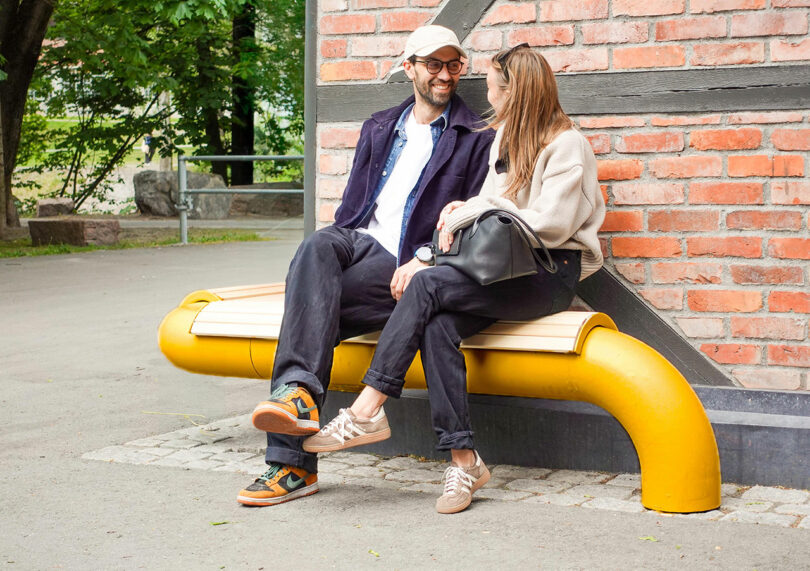
In the heart of the OUTSIDERS study lies "Venture," a project by lije studio that fundamentally questions the geometry of the traditional park bench. Venture is a masterclass in how modular seating improves social interaction in cities by stripping away the prescriptive nature of furniture. Constructed from continuous, curved steel tubing, the system meanders through public spaces like a living line of ink.
The brilliance of Venture is found in its understanding of proxemics—the study of personal space and how it dictates human behavior. Most traditional benches are linear and single-direction, forcing strangers to sit shoulder-to-shoulder in an awkward silence. Venture, however, utilizes biomorphic, fluid silhouettes that allow for varied sitting postures.
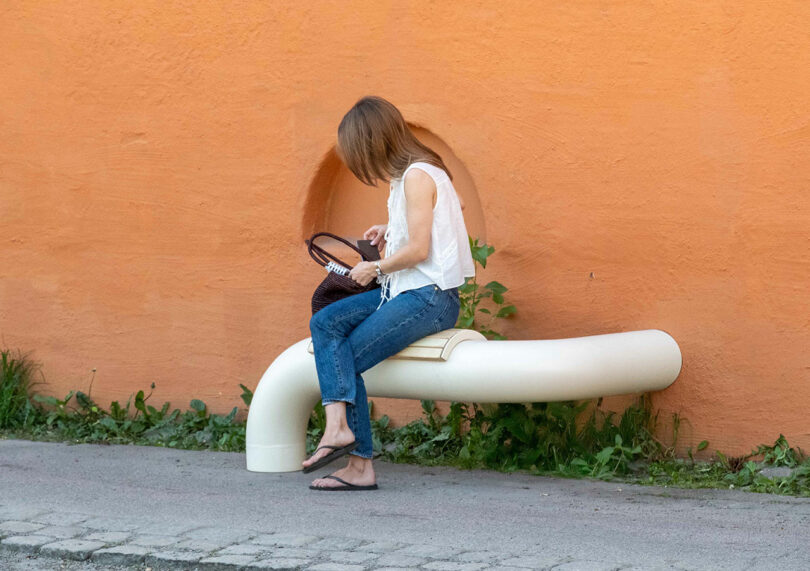
By removing the fixed backrest and creating varying heights and curves, Venture invites users to sit back-to-back, perch on the edge, or turn toward one another for conversation. This versatility is key to modern public seating design; it acknowledges that a teenager scrolling through their phone needs a different spatial relationship than two friends sharing a coffee.
The Role of Proxemics in Public Bench Design
When we look at Venture through the lens of urban psychology, we see a "Functional-to-Actionable" shift. The absence of a "front" or "back" means the furniture does not dictate how it should be used. Instead, it anchors the space, allowing the human body to find its own ergonomic flow. For landscape architects, this means the ability to specify a single system that can wrap around a tree, follow the curve of a fountain, or act as a sculptural barrier between a pedestrian path and a busy street.
The Klopp System: Rural Modularity and Circular Wood Design
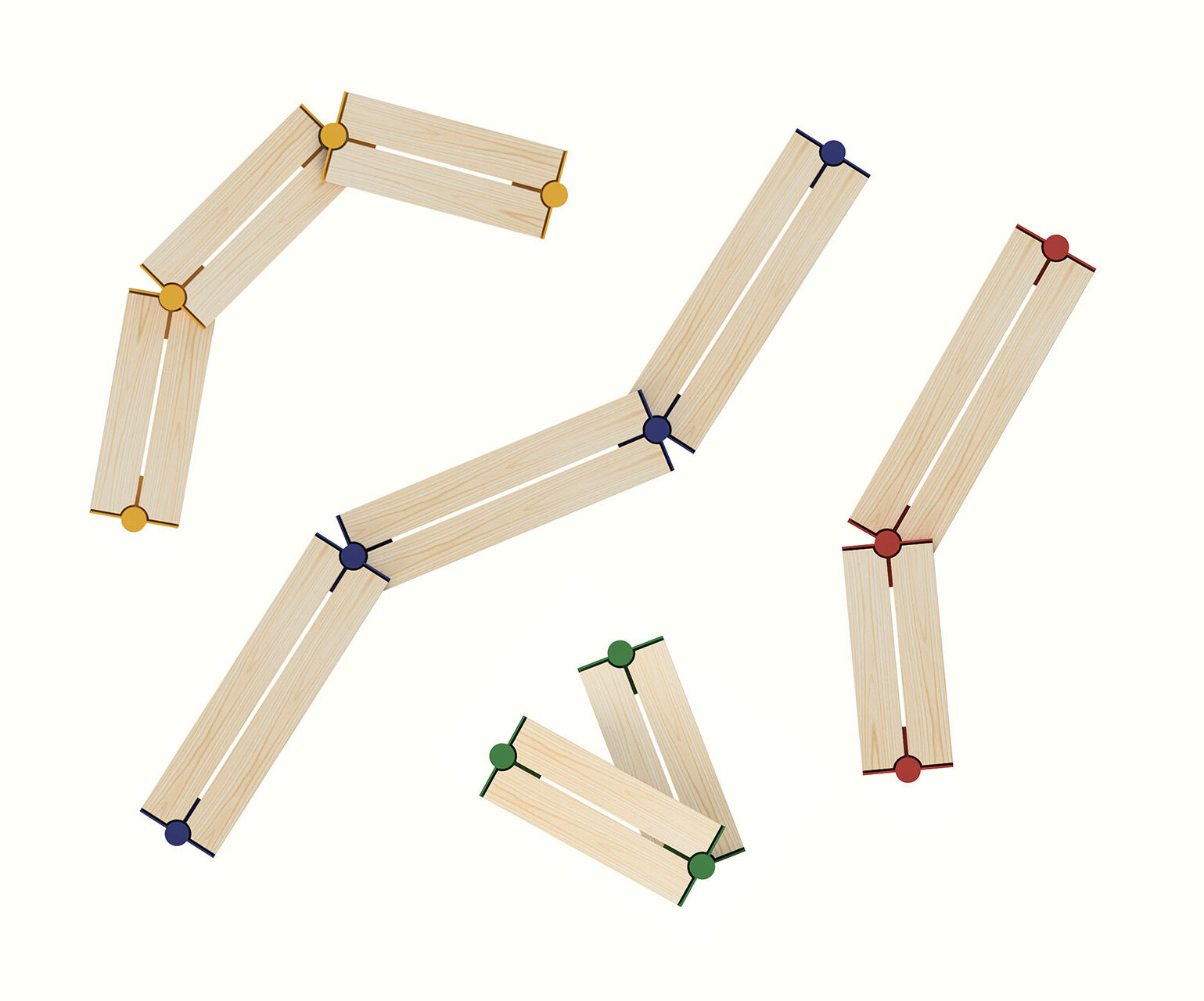
While Venture conquers the concrete jungle with steel, the "Klopp" system by Amorf Praxis turns its attention to ecologically sensitive terrains. Klopp is a profound example of how sustainable street benches can be both high-design and low-impact. Inspired by the "bog bridge"—a simple wooden path used to cross wet or uneven ground—Klopp functions as a modular urban furniture system that respects the land it sits upon.
The material choice here is deliberate. Klopp utilizes "short-stock" wood—smaller segments of timber that are often discarded in traditional manufacturing. By using these smaller pieces and connecting them with industrial pipe connectors, the system achieves a remarkable level of circularity.
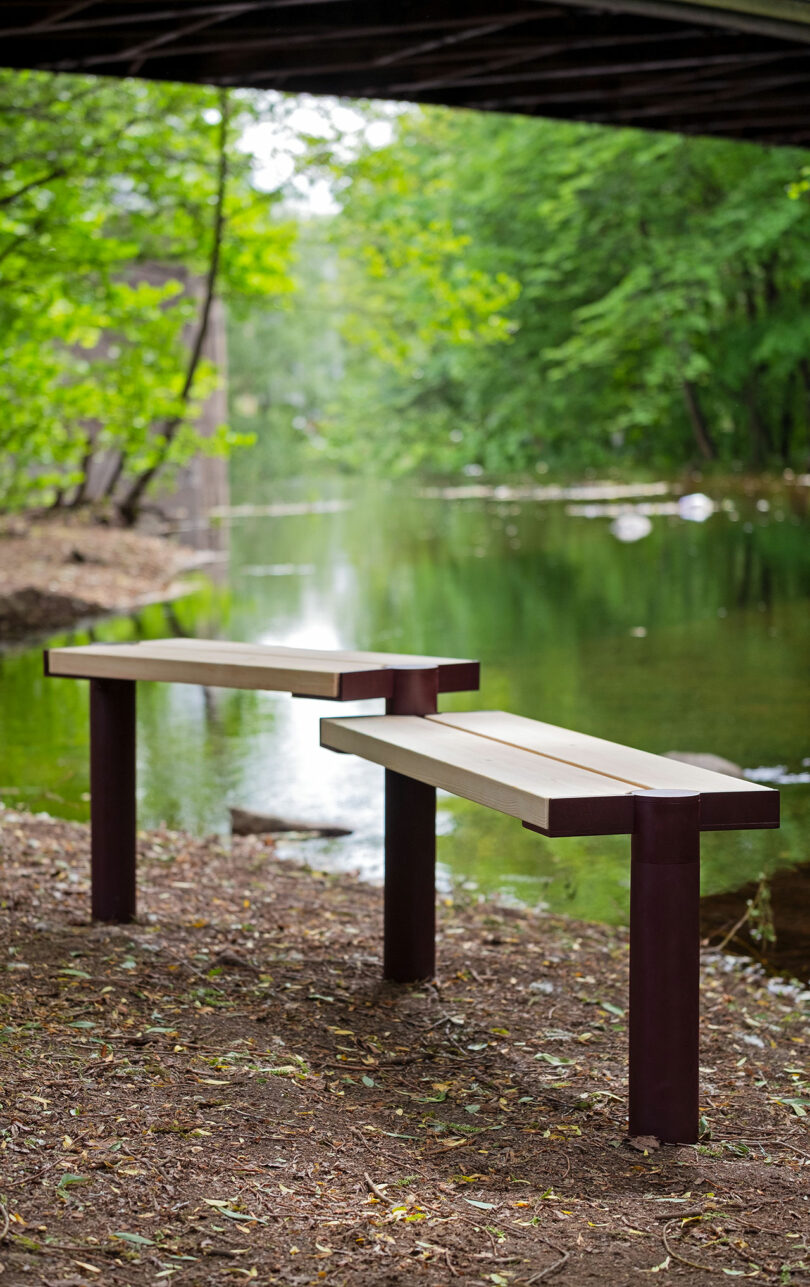
Klopp is specifically designed for site-sensitivity. Its modular frame allows it to be easily assembled, disassembled, and reused across varying terrains. This is a critical component of circular design principles for outdoor seating projects; the furniture is not a permanent scar on the landscape but a temporary, adaptable guest.
Using Recycled Industrial Materials for Park Benches
The fusion of warm, natural wood with rugged, industrial connectors creates a "Soft Industrial" aesthetic that is trending heavily for 2026. This isn't just a stylistic choice; it’s a logistical one. Because Klopp is a flexible system, it can "walk" across a riverbank or climb a hillside, providing seating where traditional, heavy-cast benches would be impossible to install.
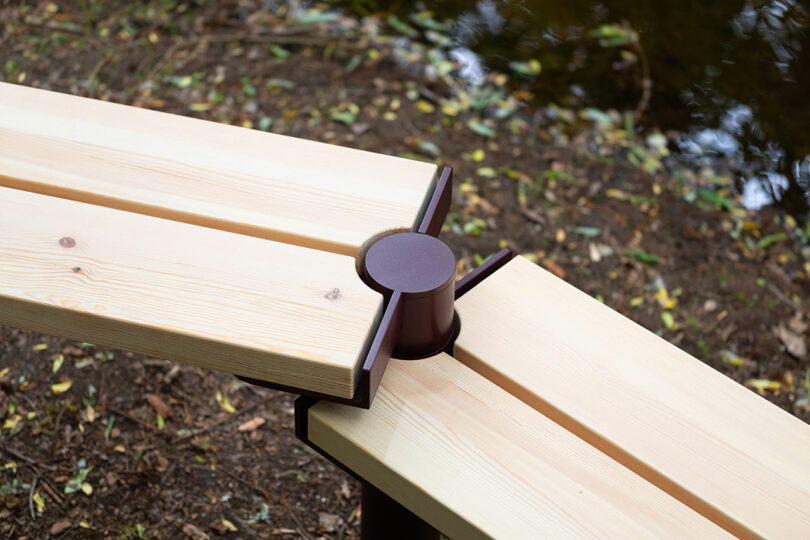
For urban planners, the Klopp system solves the problem of "liminal spaces"—those awkward gaps in the landscape that are too small for a park but too large to leave empty. By using recycled industrial materials for park benches, cities can create inviting social hubs while adhering to strict sustainability mandates.
2026 Material Trends: Biomorphic Shapes and Soft Geometry
Looking beyond the OUTSIDERS study, the broader horizon of 2026 reveals a decisive shift in material aesthetics. The "boxy" and "rigid" forms of the early 2010s are being replaced by what we call Soft Geometry. This trend, highlighted at recent events like the High Point Market, focuses on innovative street furniture for urban environments that mimics the organic curves of nature.
| Feature | 2024 (Outgoing) | 2026 (Incoming) |
|---|---|---|
| Form | Rigid, Linear, Boxy | Biomorphic, Fluid, Soft Geometry |
| Orientation | Single-direction, Fixed | Multi-directional, Non-prescriptive |
| Material | Concrete & Heavy Cast Iron | Recycled Steel Tubing & Short-stock Wood |
| Social Goal | Utility & Durability | Interaction, Solitude & Ergonomic Flow |
Biomorphic shapes are not just "curvy" for the sake of beauty; they are designed to integrate seamlessly with landscape architecture. When a bench follows the natural contours of a hill or the ripple of water, it feels like an extension of the environment rather than an intrusion.
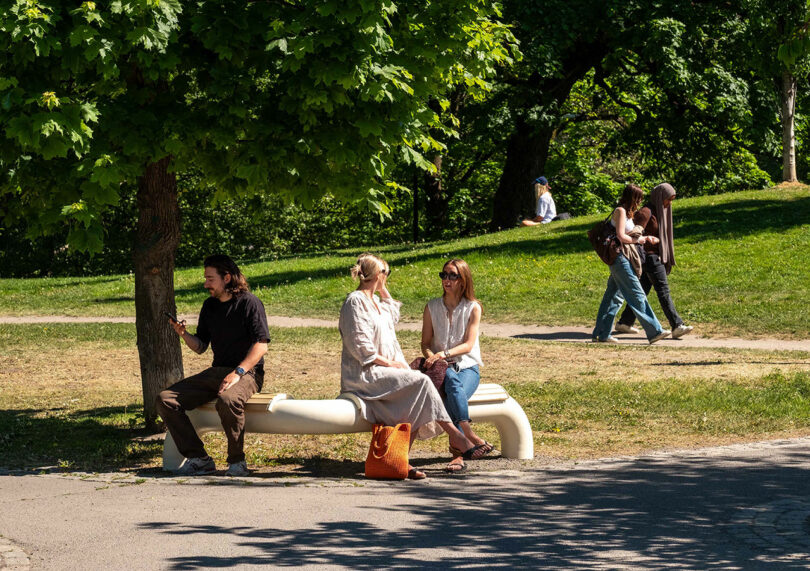
This shift toward "tactile materials" is also a response to the "loneliness epidemic." Cold, hard surfaces discourage lingering. In contrast, the use of warm wood finishes and powder-coated steel with a soft-touch texture makes public spaces feel more like an outdoor living room—a true "third space" where people feel comfortable spending time.
Implementation Guide for Landscape Architects
For professionals looking to integrate these trends into their next project, the key is to move from "placing furniture" to "designing experiences." Flexible outdoor furniture systems for landscape architects offer a toolkit to solve complex site issues.
- Map the Flow: Before selecting a piece, observe the natural "desire lines" of pedestrians. Use fluid systems like Venture to guide that flow or create "eddies" where people can gather without blocking the path.
- Specify for Agility: In modern urban design, needs change. Choose modular urban furniture that can be reconfigured for seasonal events or long-term urban redevelopment.
- Prioritize Site-Sensitivity: In natural or ecologically sensitive areas, opt for systems like Klopp that use a light touch on the ground. Avoid heavy concrete footings in favor of adjustable, modular frames.
- Balance Society and Solitude: Ensure your seating layout provides "pockets of privacy." Not everyone wants to join the crowd; providing biomorphic forms that allow a user to face away from the main path is essential for inclusivity.
Expert Tip: When designing for public spaces, always consider the "10-minute rule." If a bench doesn't offer enough ergonomic support or visual interest to keep someone comfortable for 10 minutes, it’s a missed opportunity for social connection.
FAQ
How modular seating improves social interaction in cities?
Modular seating breaks the "linear constraint" of traditional benches. By allowing for curved, circular, or multi-directional layouts, it removes the social barrier of sitting in a straight row. These designs encourage organic social gestures—like turning slightly to face a neighbor or sitting in a group circle—which naturally fosters conversation and community bonding.
What is the role of proxemics in public bench design?
Proxemics refers to the study of how humans use space to communicate comfort and intimacy. In public seating, this means designing furniture that respects "personal bubbles" while facilitating "social zones." By providing varying depths, heights, and orientations, modern designs allow users to choose their level of interaction, making the space feel safer and more welcoming.
What are the circular design principles for outdoor seating projects?
Circular design focuses on the lifecycle of the product. This includes using recycled materials (like industrial steel or off-cut wood), designing for easy repair (modular parts that can be swapped out), and ensuring that at the end of its life, the furniture can be disassembled and the materials returned to the production cycle. Systems like Klopp embody this by using standardized connectors and sustainable timber.
Conclusion: The New Standard for Modern Public Seating Design
The evolution of Modern Public Seating Design is a testament to our changing relationship with the city. We are no longer content with "good enough" infrastructure. We demand spaces that are beautiful, sustainable, and, most importantly, human-centric.
The 2026 shift toward adaptive public spaces and sustainable street benches—as seen in the Venture and Klopp systems—proves that public furniture can be a powerful tool for social good. By prioritizing modularity, circularity, and the delicate dance between society and solitude, we are not just building better benches; we are building more resilient, connected communities. As we look toward the future, the most successful urban designs will be those that treat the "third space" not as an afterthought, but as the very heart of the modern living experience.