There is a specific kind of magic that happens when the meticulous structure of a Parisian apartment meets the unstudied, "lived-in" warmth of an English country cottage. For years, the design world was enamored with "Minimalist Cream"—the safe, sterile aesthetic of white walls and bouclé furniture. However, the tide has turned. According to 2026 design forecasts, approximately 65% of high-end residential renovations are shifting toward "Layered European Heritage" styles, moving away from monochrome simplicity in favor of regional aesthetics that tell a story.
At the heart of this movement is Astrid Houssin, a French interior architect whose work serves as a masterclass in cross-channel fusion. Her method is a unique marriage of French structural elegance and English atmospheric warmth. It is characterized by bold "color-blocked" walls, precision custom joinery, and a playful use of rich, traditional palettes inspired by her dual training in both Paris and London. For readers looking to move beyond the beige, Houssin offers a roadmap for creating homes that feel both architecturally sound and deeply personal.
I. The Philosophy: Interior Architecture vs. Interior Design
To understand the Astrid Houssin method, one must first understand the distinction between an interior designer and an interior architect. Houssin identifies as the latter, focusing on the "bones" of a space before addressing its "skin."
Her 15 years spent in London, followed by a return to her native Paris, have shaped a bilingual design language. In her view, French design provides the structural rigor—the cornicing, the layout, and the symmetry—while English style provides the "hug"—the layers of textiles, the "collected" feel, and the lack of preciousness.
A cornerstone of her philosophy is the use of bespoke joinery. To Houssin, custom furniture is not an afterthought; it is a natural extension of the room's architecture. By designing cabinetry that integrates perfectly with a room’s proportions, she creates a sense of permanence and "belonging" that off-the-shelf solutions simply cannot replicate. This structural focus ensures that even when the room is filled with eclectic English patterns, it never feels cluttered or chaotic.
II. Anatomy of a Masterpiece: The Somerset Boot Room Case Study
Nowhere is the Houssin method more evident than in her recent transformation of a four-bedroom cottage in Bruton, Somerset. This project highlights a growing trend: internal data suggests a 45% increase in demand for "transitional utility spaces" like boot rooms, where homeowners are now prioritizing aesthetic continuity between functional extensions and the main house.
Houssin’s approach to the Somerset boot room was to treat a functional space with the same reverence as a drawing room. The standout feature is her signature "Color-Block" wall, a technique she uses to define space and add architectural weight without needing to move physical walls.
The Palette Breakdown
The Somerset palette is a sophisticated exercise in color theory, utilizing high-pigment shades that shift beautifully with the changing English light:
- The Anchor (Lower Half): Farrow & Ball’s Red Earth. This warm, terracotta-based hue provides a grounded, earthy foundation that feels quintessentially "Country."
- The Lift (Upper Half): Farrow & Ball’s Off White. A soft, traditional cream that prevents the room from feeling heavy, reflecting light into the deeper corners.
- The Border (The Girdle): A defining line in Little Greene’s Purple Brown. This thin, dark border acts like a frame, separating the two main colors and adding a sharp, modern edge to the traditional tones.
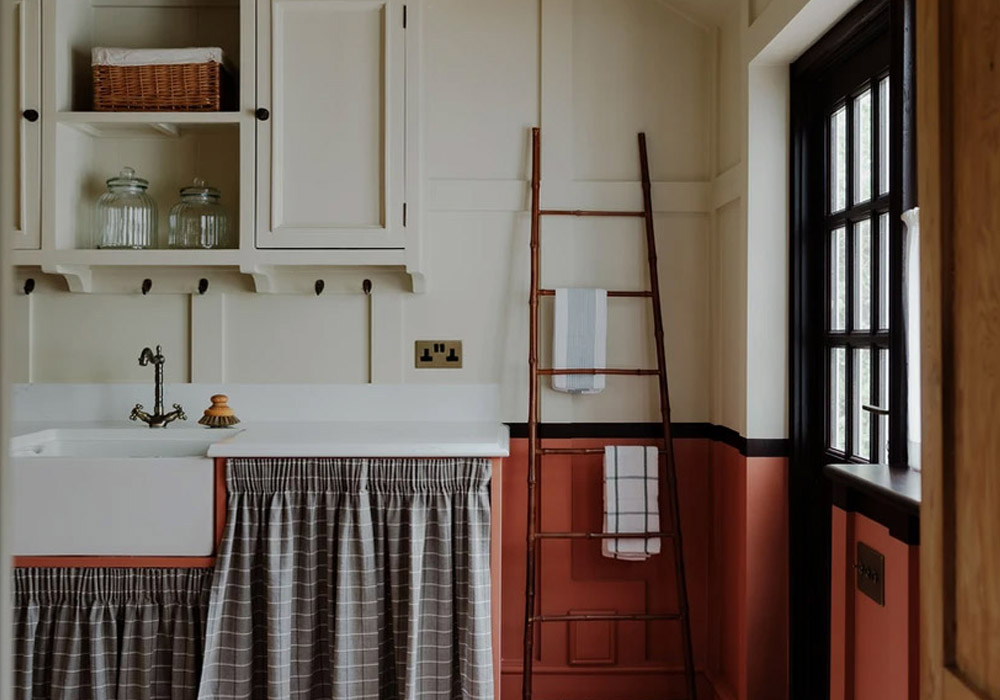
Beyond the paint, the material selection reinforces the French-English blend. Houssin chose Seville Hexagon faux terracotta tiles for the floor—durable enough for muddy boots but elegant in their geometry. The countertops are a hardy Fugenstone quartz, balanced by the charm of a "cafe curtain" beneath the sink, a classic English cottage touch that softens the hard lines of the cabinetry. This color-block theme was even carried into the adjacent pocket-sized WC, proving that even the smallest spaces deserve a grand design gesture.
III. French Country meets English Cottage: The 2026 Fusion Guide
The secret to blending these two iconic styles lies in the balance between French structure and English warmth. If you are looking to replicate this look, the key is to use French design to guide the "hard" elements of the room and English style to layer the "soft" elements.
| Element | French Influence (The Structure) | English Influence (The Atmosphere) |
|---|---|---|
| Walls | Paneled wainscoting and architectural moldings | Layered wallpaper or "Unexpected Red" paint accents |
| Furniture | Symmetry, cabriole legs, and carved wood | Overstuffed armchairs, mismatched antiques, and footstools |
| Lighting | Gilded chandeliers or minimalist French sconces | Fabric-shaded lamps with pleated patterns |
| Textiles | Heavy linens and silk velvets in solid colors | Floral chintz, checks, and hand-blocked prints |
The 2026 Color Palette
Looking toward the next few years, the palette is shifting away from safe neutrals. We are seeing a move toward:
- Powder Blue & Sage Green: Used as neutrals to create a serene, garden-inspired backdrop.
- The "Unexpected Red": Deep burgundy or oxblood used as a "new neutral" for trims, window frames, or small pieces of furniture to provide a focal point.
- Pattern Play: The 2026 trend involves pairing oversized French roses (structural and bold) with delicate English meadow prints (small-scale and intricate).
Pro Tip: When mixing patterns, keep the color story consistent. If your English floral has a hint of sage green, ensure your French stripe or solid velvet picks up that exact tone to create visual harmony.
IV. Elements of Longevity: Texture and Handcrafted Heritage
As we move toward 2026, the design world is seeing a massive resurgence in "Craft and Heritage" as a direct response to the rise of AI and mass-produced furniture. Astrid Houssin’s method celebrates the "imperfect" and the tactile.
One major trend to watch is "Wood Drenching." This involves using timber across floors, walls, and even ceilings to create a "cocooning" environment. Unlike the rustic barn looks of the past, the modern version is refined—think hand-finished oak with subtle graining and matte oils.
We are also seeing a shift toward:
- Textured Window Frames: Moving away from flat plastic or metal toward painted wood with visible grain.
- Hand-Finished Tiles: Embracing the "Zellige" style or hand-poured encaustic tiles that offer slight variations in color and texture.
- Rustic Nomadic Surfaces: Incorporating woven rugs and rough-hewn wooden stools that add a sense of history and global travel.

V. The Practical Trend: The Rise of the Mini Boot Room
You don’t need a sprawling Somerset estate to apply these principles. The "Mini Boot Room" has become a staple of modern urban design. By carving out a small "transitional utility space" in a hallway or under a staircase, you can manage the chaos of daily life while maintaining a high-design aesthetic.
To make the most of a small footprint, consider these essential features:
- Recessed Coir Matting: Set your doormat into the floor so it’s flush with your tiles. It looks cleaner and catches more dirt.
- Custom Benches: A built-in bench with storage underneath provides a place to sit while pulling off boots and hides unsightly footwear.
- Integrated Lighting: Use motion-sensor LED strips inside cabinetry or a beautiful wall sconce to make the space feel inviting rather than purely utilitarian.
VI. FAQ
How do I choose between French Country and English Cottage if I like both? You don't have to choose! Follow the Astrid Houssin method: use French principles for the layout and "built-in" elements (like cabinetry and moldings) and English elements for the "movable" items (like rugs, pillows, and lamps).
Isn't "Color-Blocking" too bold for a small house? Actually, color-blocking can make a small house feel larger. By using a darker color on the bottom half of a wall, you "anchor" the room, while a lighter color on top draws the eye upward, creating the illusion of height.
What is the "Unexpected Red" trend mentioned for 2026? This is a design theory where adding a small amount of red to a room that doesn't "match" actually makes the whole space look better. In the French-English mix, this might be a burgundy picture frame or a red-toned wood stain on a chair.
VII. Final Thoughts
Mastering the mix of French flair and English style is about more than just buying the right furniture; it’s about a change in mindset. It’s about valuing the architectural "bones" of your home as much as the decor you put inside it. Whether you are embarking on a full-scale renovation or simply repainting a utility room, the Astrid Houssin method reminds us that the most beautiful homes are those that balance elegance with comfort, and structure with soul.
As we look toward 2026, the shift is clear: we want homes that feel curated, not decorated. We want spaces that feel like a "warm hug" but look like a Parisian salon. By embracing color, texture, and heritage, you can create a space that is truly timeless.