Quick Facts
- Location: Trousdale Estates, Beverly Hills, CA.
- Original Architect: Benton & Parks (1966).
- Restoration Firm: Studio OSKLO.
- Architectural Style: Mid-century Modern Post-and-Beam.
- Key Features: Structural steel facade, slab limestone fireplaces, and a new Japanese-inspired central atrium.
- Sustainability Impact: Restoring this structure reduced construction waste by approximately 65% compared to a modern tear-down and rebuild.
In the sun-drenched hills of Beverly Hills lies Trousdale Estates, a neighborhood that feels less like a zip code and more like a living museum of mid-century optimism. With approximately 540 single-story residences, it is one of the most concentrated collections of 1950s and 60s modernism in the United States. Here, the "pedigree" of a home isn't just a marketing buzzword; it is a historical mandate. When Studio OSKLO took on the 1966 Benton & Parks residence, they weren't just looking at a renovation project. They were engaging in an act of architectural stewardship, breathing new life into a classic post-and-beam specimen that many developers would have simply razed to the ground.
What is Post-and-Beam Construction?
To understand the magnitude of Studio OSKLO’s feat, one must first understand the "bones" of the building. Post-and-beam construction is a building method that utilizes heavy timber (or steel) columns (the posts) and horizontal supports (the beams) to create the skeleton of a home.
Unlike traditional "stud" or "stick-frame" construction where the walls are load-bearing, the post-and-beam system carries the entire weight of the roof on its frame. This structural independence allows for two defining characteristics of mid-century modernism:
- Wide-Open Interior Spaces: Without the need for interior load-bearing walls, rooms can flow seamlessly into one another, creating grand, uninterrupted spans.
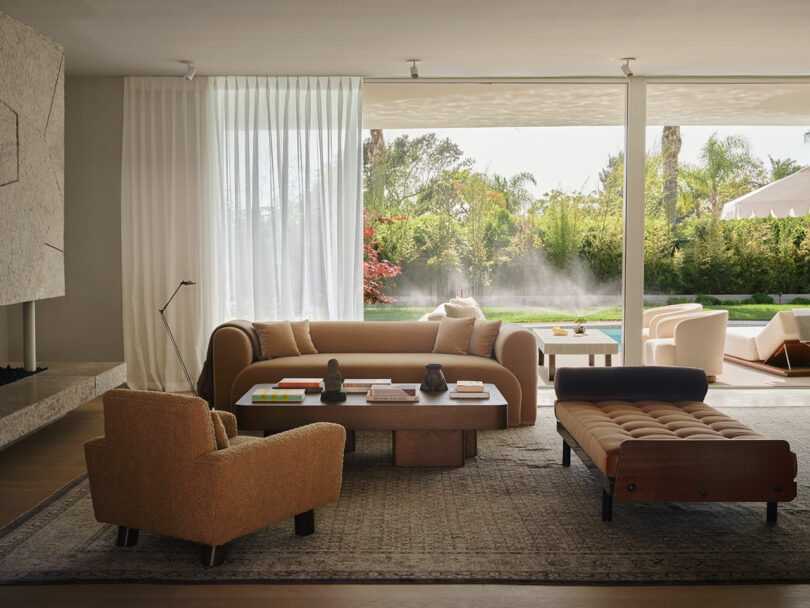
- Expansive Glass Walls: Because the walls don't hold up the house, they can be replaced entirely by floor-to-ceiling glass, effectively "dissolving" the boundary between the indoors and the landscape.
The Restoration Feat: Preserving the 1966 Benton & Parks Residence
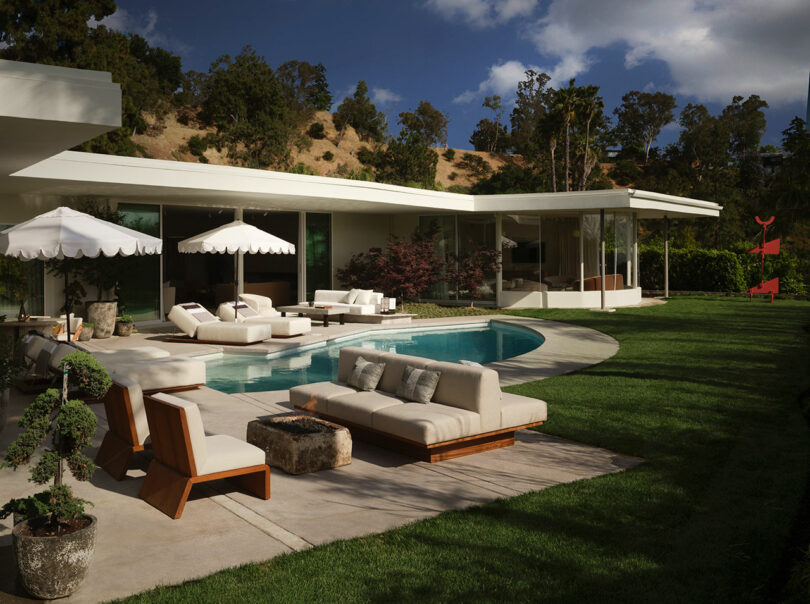
For Studio OSKLO, the challenge was to modernize the home without erasing its 1966 soul. The original Benton & Parks design was a masterclass in horizontal composition, a low-slung profile that hugged the topography of the hills. The restoration team made the conscious decision to maintain the original structural steel facade and the single-story layout—a choice that honors the strict building codes of Trousdale Estates while celebrating the era's restraint.
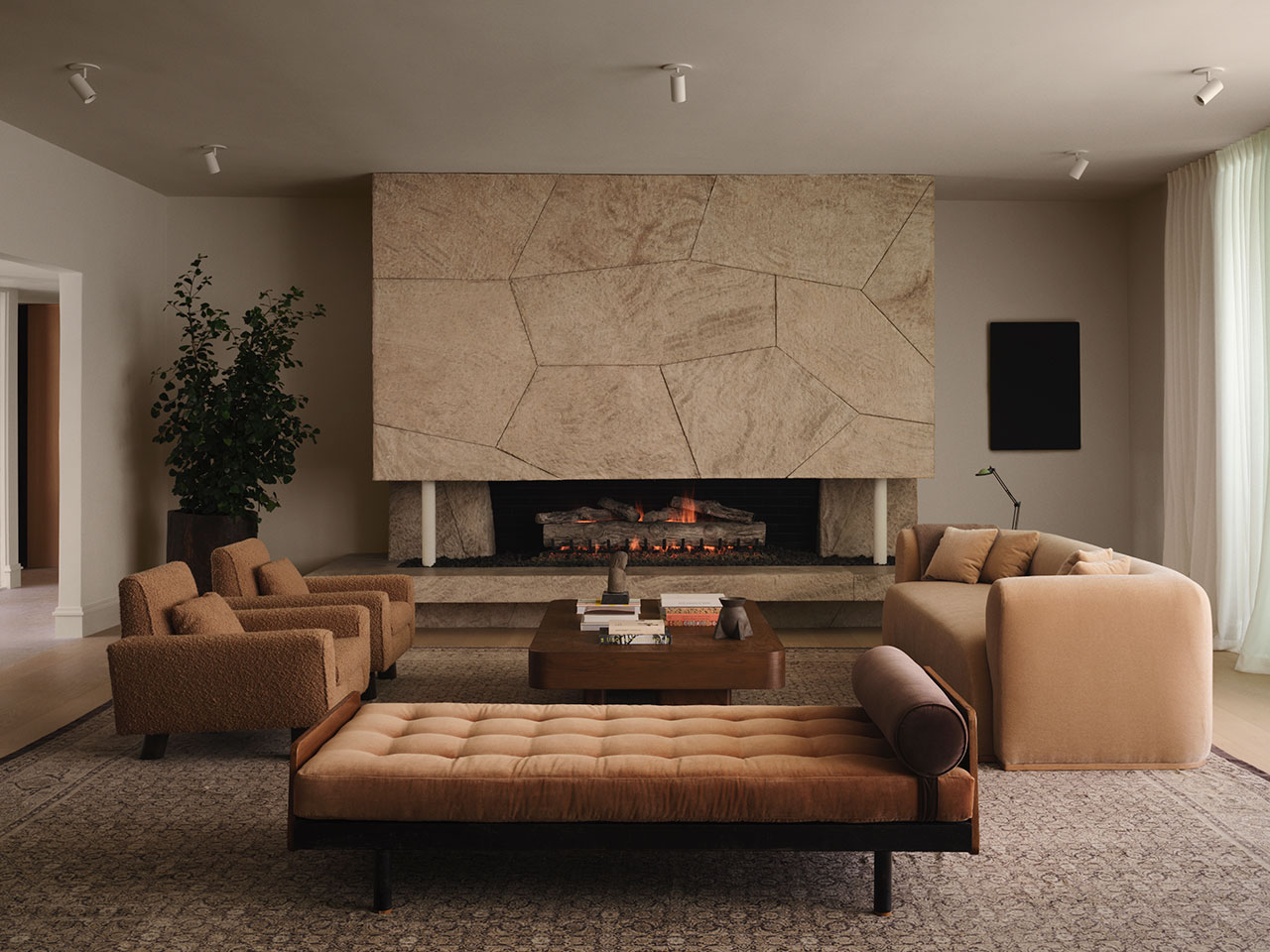
One of the most striking successes of the project is the treatment of the original materials. The team meticulously restored the home’s massive slab limestone fireplaces and silver travertine walls. These elements act as tectonic anchors, providing a sense of permanence and weight against the ethereal lightness of the glass walls.
"Restoration is not about making a house look new; it’s about making it look like the best version of itself across time. We wanted to preserve the original structural rhythm while introducing a contemporary sense of 'calm' that the 1960s often lacked." — Studio OSKLO Philosophy
Beyond mere cleaning, the studio integrated a stunning Japanese-inspired atrium into the heart of the home. By carving out this central void, they allowed natural light to penetrate the deepest parts of the floor plan, transforming a 1960s footprint into a 2026-ready sanctuary.
Materiality and Interior Design: A Dialogue Between Eras
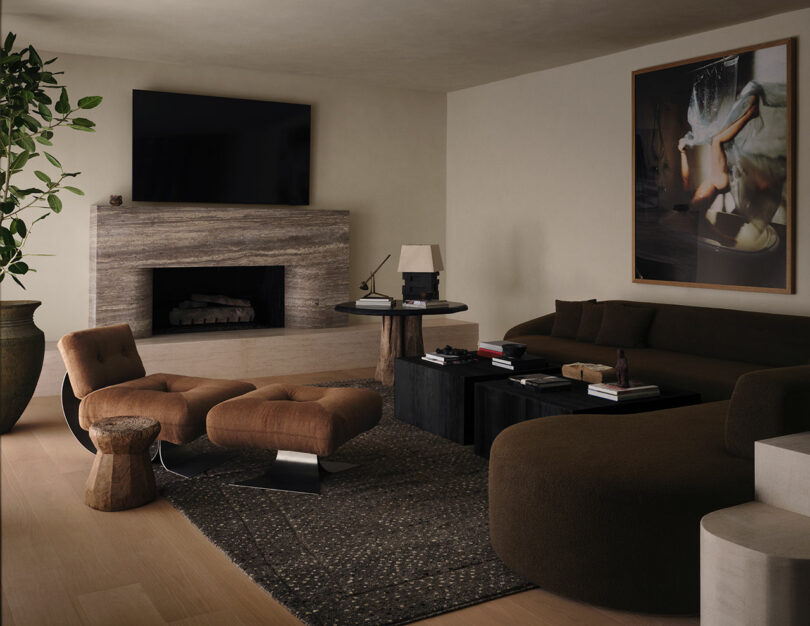
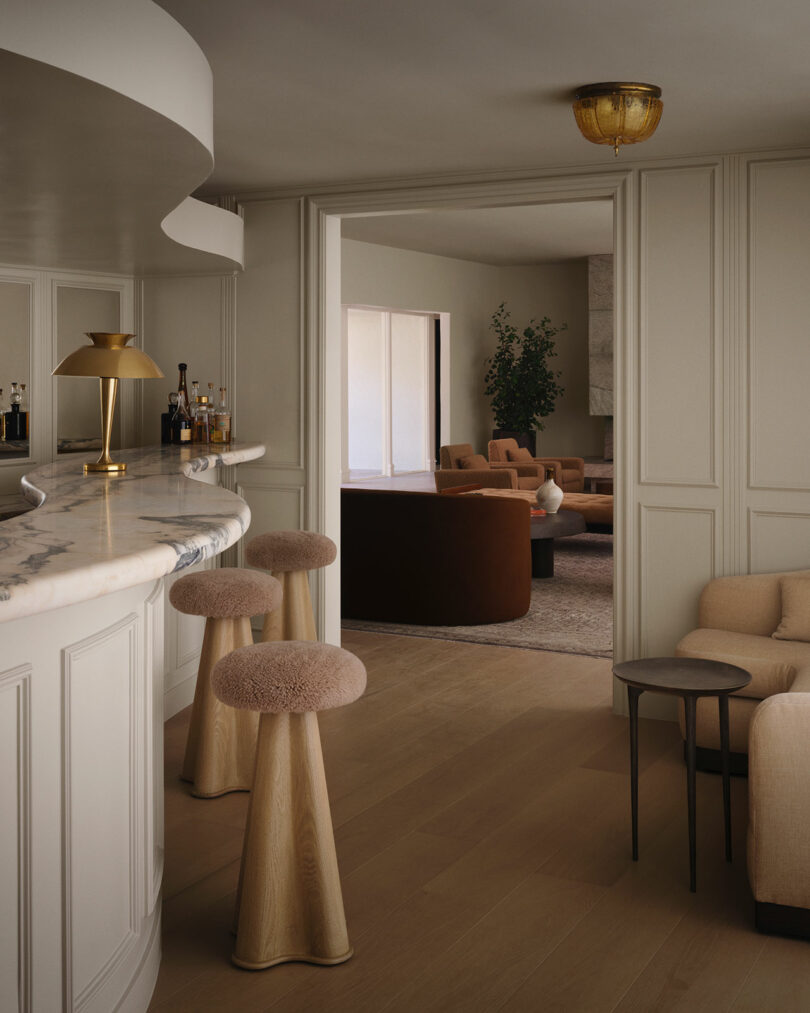
Stepping inside the OSKLO house feels like walking through a curated dialogue between the 1960s and the present day. The palette is a sophisticated mix of lighter oak, saw-cut concrete, and muted earth tones that mirror the surrounding chaparral of the Santa Monica Mountains.
To furnish the space, the studio leaned into their own "Trousdale Collection"—a line of furniture inspired by the local landscape. The design ethos here is one of "tactile luxury." You’ll find sculptural elements like Paul Evans Brutalist pulls and custom ironwork paired with soft, rounded forms. The lighting is particularly inspired, mixing 1960s Italian fixtures with the glamorous "Hollywood Regency" spirit that originally defined the neighborhood.
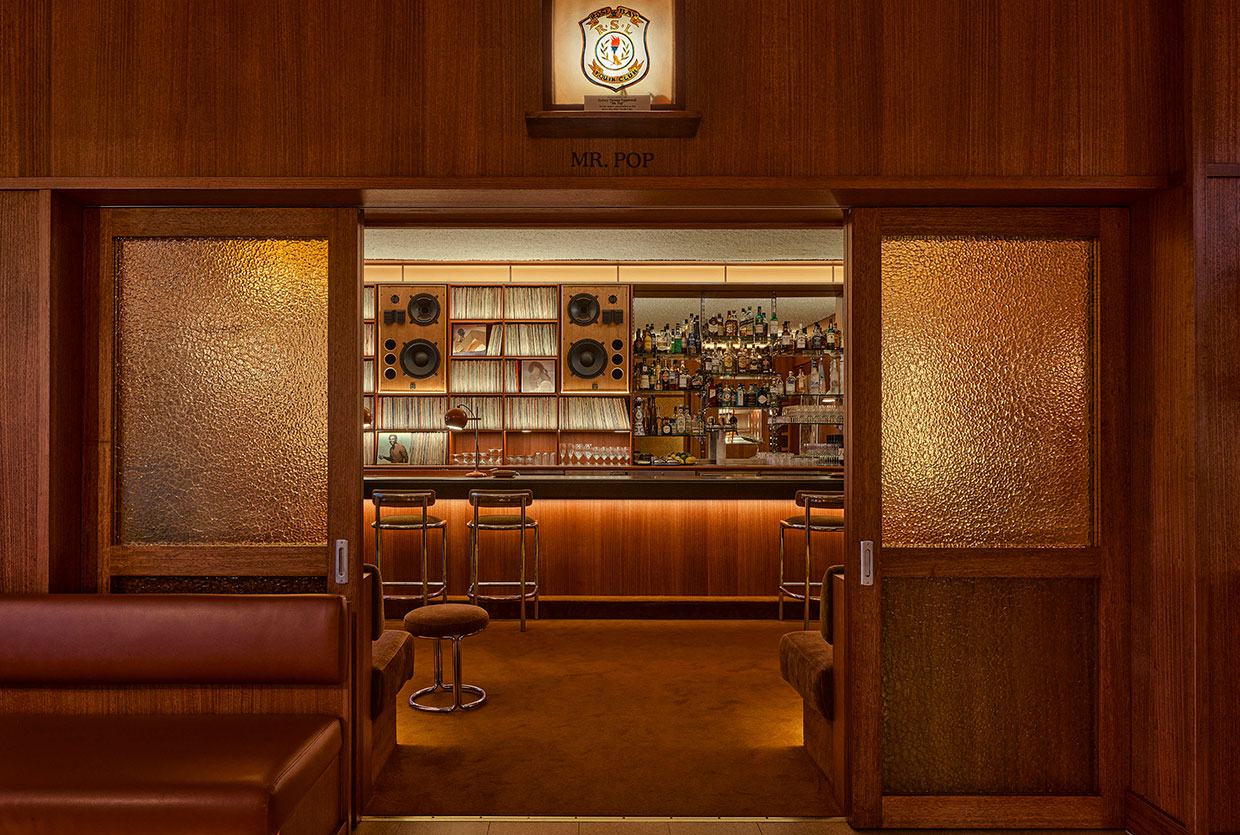
A standout feature is the curved marble bar, which serves as a functional piece of art. It reflects the project’s wider commitment to custom craftsmanship, proving that even in a home defined by straight lines and "perfect planes," there is plenty of room for organic, sculptural expression.
Sustainability: The Case for Restoration Over Demolition
In an era where "new" is often equated with "better," the restoration of the Benton & Parks residence makes a powerful environmental statement. Architectural stewardship is, at its core, a form of sustainable timber construction and carbon management.
When a mid-century home is demolished, the "embodied carbon"—the energy already spent to harvest, transport, and build the original structure—is lost, and the process contributes significantly to landfills. By choosing restoration over a total tear-down, Studio OSKLO reduced construction waste by an estimated 65%.
| Feature | Restoration (Studio OSKLO) | Typical Modern Tear-Down |
|---|---|---|
| Construction Waste | Reduced by up to 65% | High (complete debris) |
| Embodied Carbon | Preserved in original steel/stone | Lost; replaced by new high-impact materials |
| Historical Pedigree | Retained and appreciated | Erased forever |
| Neighborhood Integrity | Respects the 540-home collection | Disrupts the aesthetic fabric |
By keeping the "bones," the project demonstrates that sustainable luxury in 2026 isn't just about solar panels; it’s about the longevity of the materials we already have.
Poetic Gestures: The Japanese Atrium and Landscapes
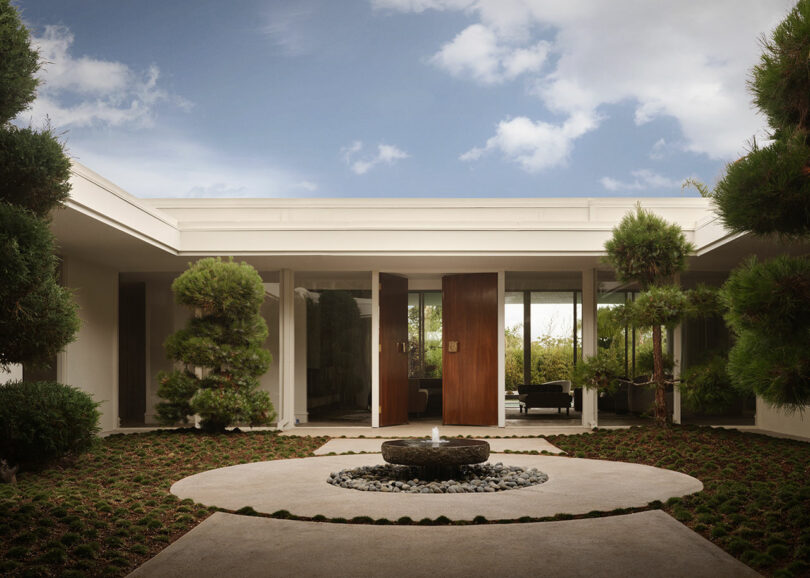
The most "OSKLO" touch in this residence is the central atrium. It is a poetic gesture that transforms the house from a mere shelter into a meditative environment. This stylized Japanese garden, complete with sculptural bonsai pines and a stone fountain, serves as the home’s lungs.
The indoor-outdoor flow is orchestrated with surgical precision. From the moment you enter the courtyard, your sightlines are directed through the glass-walled living areas toward the Santa Monica Mountains and the distant, glowing skyline of Century City. The pool and garden have been re-oriented to capitalize on these views, ensuring that the architecture remains a frame for the natural world.
The OSKLO House: An Immersive Design Environment
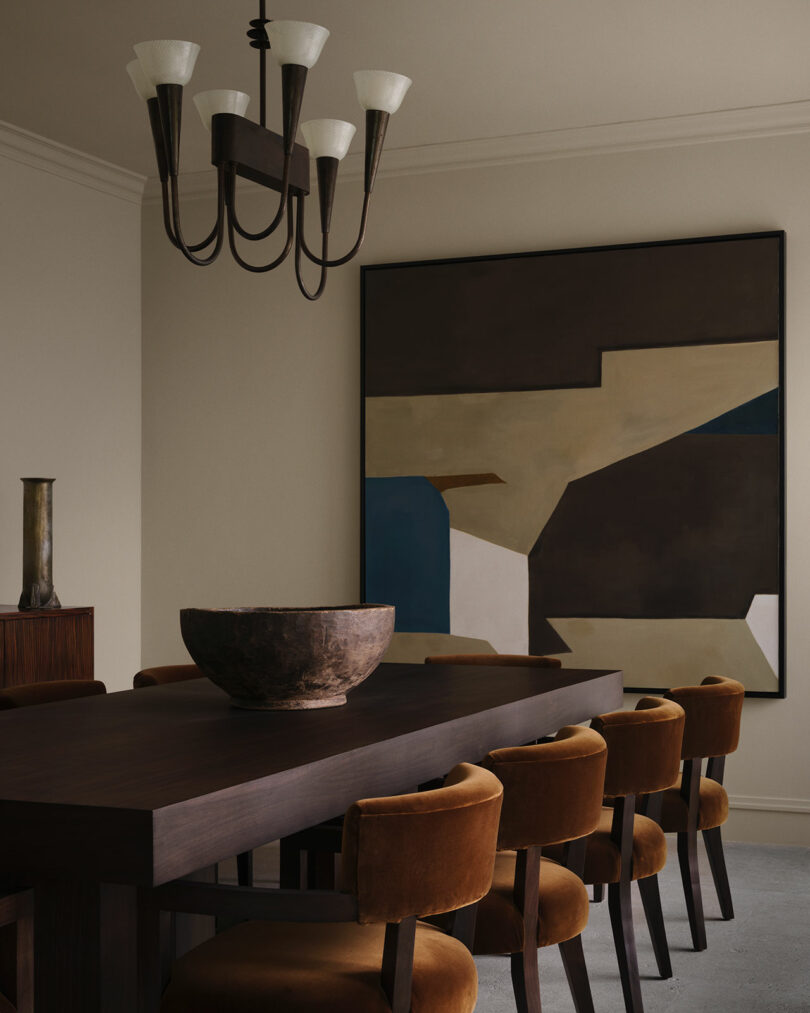
This is more than just a home; it is a gallery for living. Studio OSKLO has used the Benton & Parks residence as a canvas for a curated collection of fine art and high-concept furniture. The walls are adorned with works from Julian Schnabel and Ed Ruscha, while the living spaces feature avant-garde pieces from the Campana Brothers.
This "immersive" approach to interior design ensures that every corner of the house has a narrative. The custom furniture from Studio OSKLO's own line feels at home here because it was born from the same design language as the architecture—clean, honest, and deeply rooted in the California lifestyle.
The restoration of this 1966 gem is a reminder that great architecture doesn't have an expiration date. By valuing the structural integrity of the post-and-beam method and the textural history of limestone and travertine, Studio OSKLO has created a residence that feels both nostalgic and prophetic. It is a testament to the fact that sometimes, the most radical thing a designer can do is preserve.
FAQ
Q: Why is post-and-beam construction specifically associated with mid-century modern homes? A: Because the structural load is carried by a frame of posts and beams rather than interior walls, architects in the 1950s and 60s were finally able to use large expanses of glass. This allowed them to achieve the "indoor-outdoor" lifestyle that became the hallmark of California modernism.
Q: Is it more expensive to restore a post-and-beam home than to build new? A: Initially, restoration can be complex due to the precision required to update exposed structural elements. However, when you factor in the value of the historical pedigree and the significantly lower environmental impact (65% less waste), it is often considered a superior long-term investment for high-end real estate.
Q: What are the main challenges in restoring a 1960s residence in Beverly Hills? A: The primary challenges are bringing the home up to modern energy and seismic codes without thickening the rooflines or walls, which would ruin the "thin" aesthetic typical of the era. Studio OSKLO achieved this through clever integration of systems within the existing footprint.