The Woman Who Questioned Everything
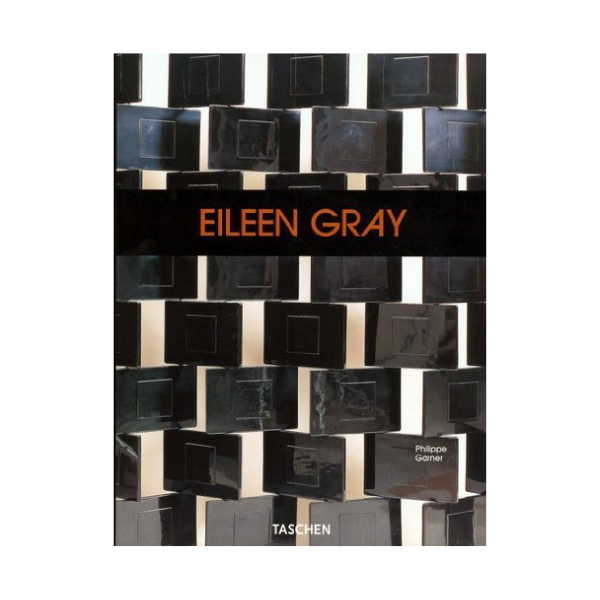
Her name is now instantly recognizable, a staple in the pantheon of 20th-century design, which makes the fact that she didn’t garner true global recognition until she was well into her 90s even more shocking. For much of her life, Eileen Gray (1878–1976) was the "invisible" pioneer of the Modernist movement. While her male contemporaries were busy branding their architectural manifestos, Gray was quietly reinventing the relationship between the human body and the spaces it inhabits.
Who was Eileen Gray? Born into an aristocratic Irish-Scottish family, Gray was a visionary architect and designer who spent most of her adult life in Paris. She was a woman of "firsts": she was one of the first women admitted to the Slade School of Fine Art in London, the first to master the ancient Oriental art of lacquer in the West, and one of the few women to successfully transition from decorative arts to avant-garde architecture. Her philosophy was deceptively simple but radically subversive: "To create," she once said, "one must first question everything."
The paradox of her life lies in its timing. While she was a central figure in the Parisian salons of the 1920s, her work fell into obscurity following World War II. It wasn't until 1972, when a collector sold her "Pirogue" daybed for a record-breaking price, that the design world suddenly turned its gaze back to the woman living quietly in her apartment on the Rue Bonaparte. By then, she was 94 years old.
Mastery of the Slow Craft: The Lacquer Years
Before she was an architect, Eileen Gray was a master of texture and time. Her journey into the world of design began at the Victoria & Albert Museum, where she fell under the spell of Japanese lacquerware. Unlike the industrial, mass-produced spirit that would later define much of modernism, Gray’s early work was rooted in the "slow craft."
In 1907, she began an apprenticeship with the Japanese artisan Seizo Sugawara. To master lacquer is to master patience. The process is grueling, involving over 20 demanding steps. Each layer of lacquer must be applied with surgical precision and left to set for at least 72 hours in a highly humid environment. If the dust levels aren't controlled or the humidity fluctuates, the entire piece can be ruined.
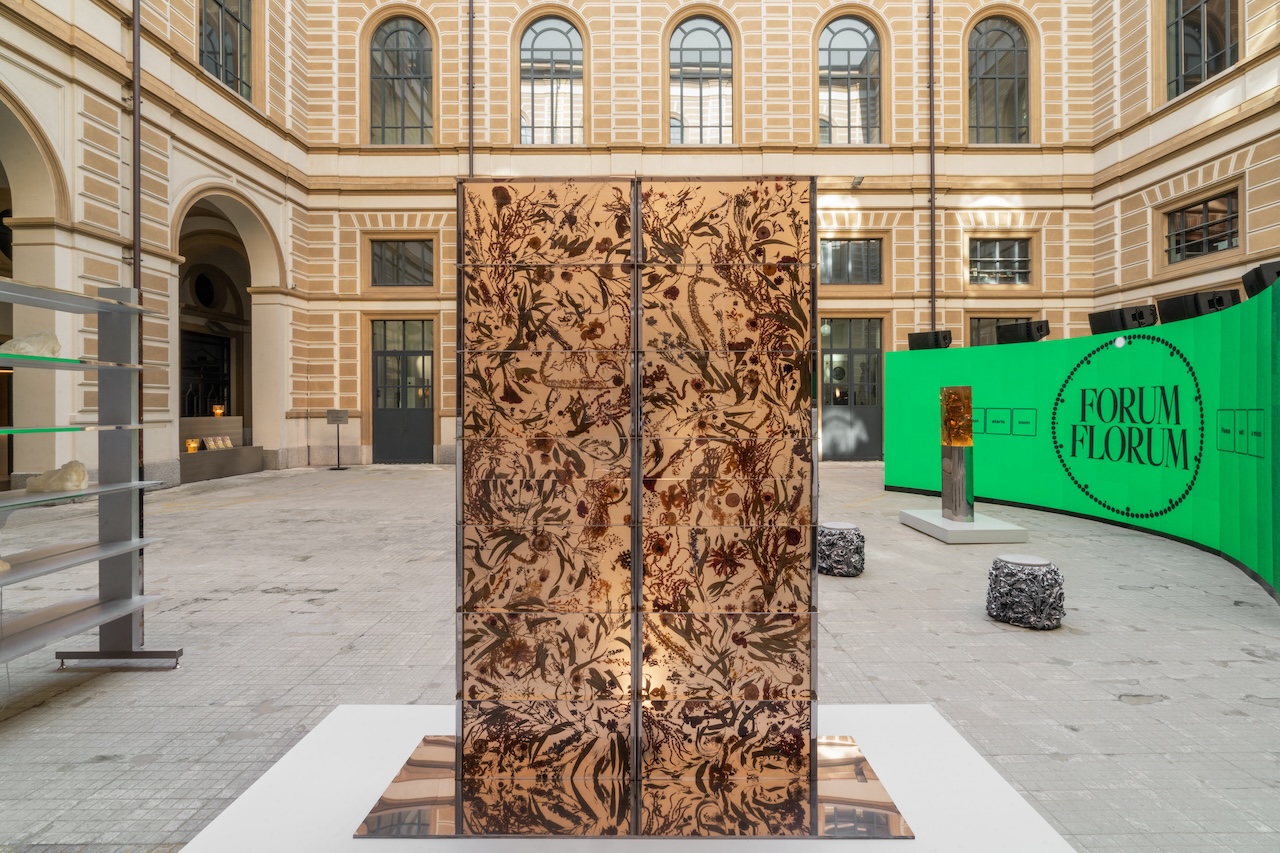
Gray spent years in this meditative, chemical-laden process. Her mastery eventually led to the opening of Galerie Jean Désert in Paris in 1922. The gallery was her stage, where she displayed intricate lacquer screens and "brick" walls that blurred the line between furniture and architecture. These pieces were not merely decorative; they were experiments in how to divide space without closing it off—a theme that would eventually lead her to the shores of the French Riviera.
"A house is not a machine to live in; it is the shell of man, his extension, his release, his spiritual emanation." — Eileen Gray
Villa E-1027: The 'Living Organism' by the Sea
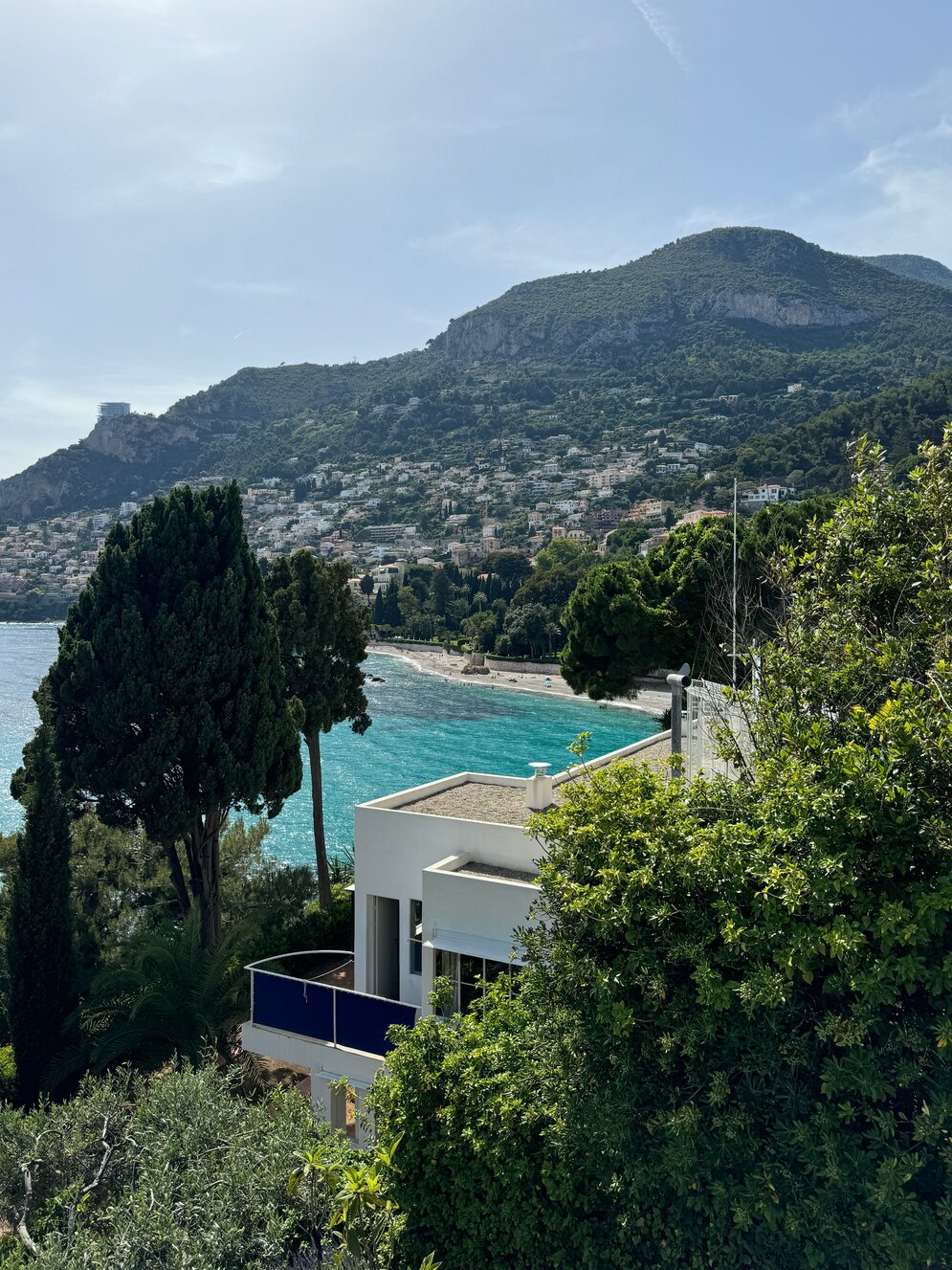
At the age of 48, having never formally studied architecture, Eileen Gray began work on her first and greatest masterpiece: Villa E-1027. Nestled on a steep cliff overlooking the Mediterranean at Roquebrune-Cap-Martin, the villa was completed in 1929. It was not just a house; it was a manifesto of "warm modernism."
What is Villa E-1027? It is a seaside retreat designed as a 'living organism' that balances avant-garde aesthetics with intimate tranquility. While the International Style of the time—led by figures like Le Corbusier—championed the "house as a machine," Gray argued that such an approach was cold and soul-less. She wanted a home that responded to the rhythm of the sun, the sound of the waves, and the individual needs of its occupants.
The name E-1027 is a secret code of affection between Gray and her then-partner, the Romanian architect Jean Badovici:
- E stands for Eileen.
- 10 represents 'J' (the 10th letter of the alphabet for Jean).
- 2 represents 'B' (the 2nd letter for Badovici).
- 7 represents 'G' (the 7th letter for Gray).
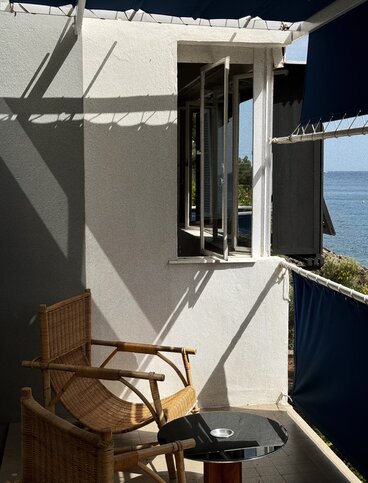
The villa’s aesthetic is deeply nautical. Gray was fascinated by the efficiency and romance of ocean liners. She utilized pilotis (reinforced concrete stilts) to elevate the structure, much like a ship at dock. She added canvas awnings that mimicked sails and used blue and white color palettes that invited the sea inside.
Humanizing Modernism: Interior and Furniture
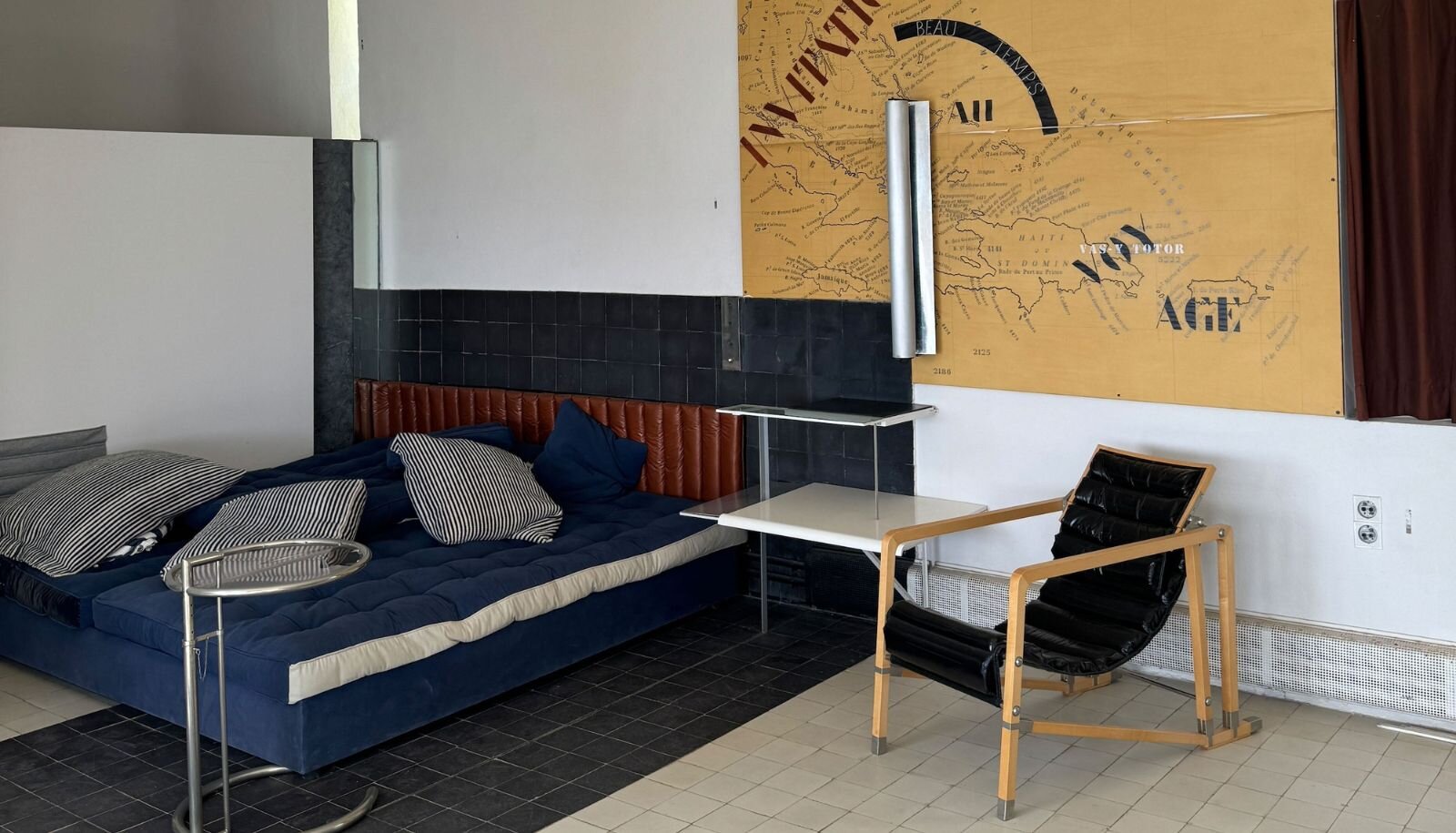
Gray’s transition from lacquer to architecture allowed her to approach the interior of Villa E-1027 with microscopic detail. She didn't just design the walls; she designed the "choreography" of life within them. For Gray, comfort was not a luxury; it was a design requirement.
Her most famous designs were born from specific needs within the villa. She rejected the idea that one chair should fit all people for all activities. Instead, she created pieces that were adjustable, multi-functional, and playful.
Key Iconic Designs:
- The Bibendum Armchair: Inspired by the Michelin Man, this chair features two plush, semi-circular tubes. It was a direct rebuttal to the austere, spindly furniture of her contemporaries. It offered a sense of embrace and humor.
- The E-1027 Adjustable Table: Perhaps her most famous work, this chrome-and-glass table was designed specifically for her sister, who loved to eat toast in bed. The height is adjustable, and the base is open so it can slide over the edge of a mattress to prevent crumbs from falling on the sheets.
- The Pirogue Daybed: A nod to her lacquer roots, this boat-shaped sofa is finished in deep brown lacquer and silver leaf, embodying the transitional period between Art Deco opulence and Modernist restraint.
| Piece | Primary Materials | Key Feature |
|---|---|---|
| Bibendum Chair | Steel frame, leather upholstery | Oversized tubular "tires" for maximum comfort |
| E-1027 Table | Polished chrome, clear glass | Height-adjustable telescoping stand |
| Transat Chair | Lacquered wood, fabric/leather | Inspired by steamship deck chairs |
| Screen | Lacquered wood panels | Operates as a "movable wall" to partition space |
The Le Corbusier Controversy: Vandalism or Art?
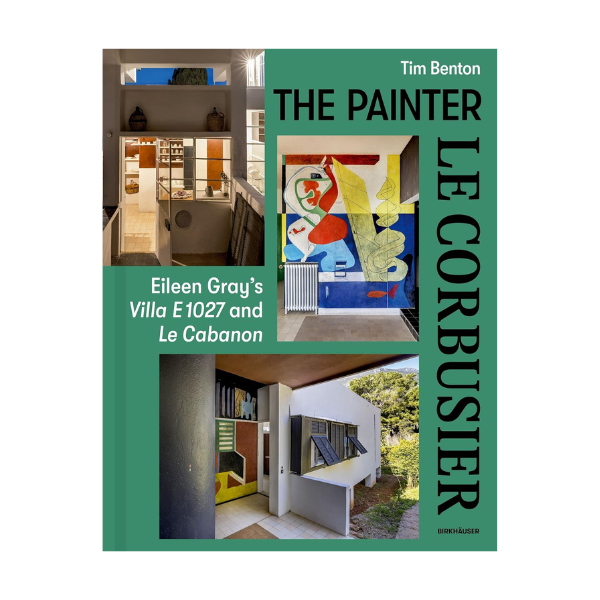
One cannot tell the story of Villa E-1027 without addressing the shadow cast by Le Corbusier. A friend of Badovici, the famous architect was obsessed with the villa, eventually building his own tiny wooden cabin (Cabanon) right next to it.
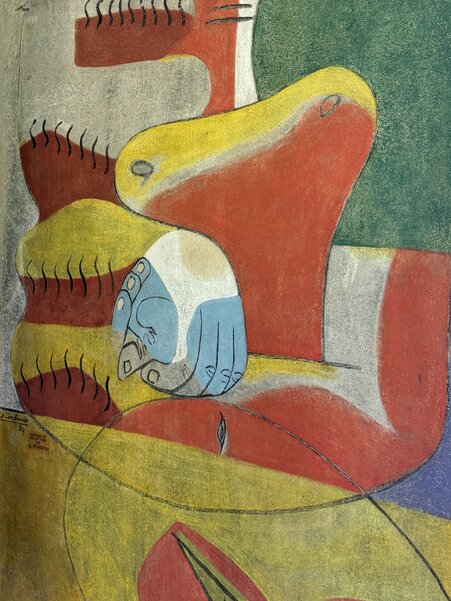
However, in the late 1930s, while Gray was no longer living there, Le Corbusier took it upon himself to paint eight massive, colorful murals on the villa's pristine white walls—often while working in the nude. Gray was horrified. She viewed the murals as a "vandalism" of her architectural intent. She had designed the walls as quiet, meditative surfaces to catch the light; Le Corbusier had turned them into a loud, external gallery.
The irony is that for decades, the murals (and the villa itself) were attributed to Le Corbusier. It was a classic erasure of a female pioneer by a male contemporary. Gray's minimalist "white" modernism was literally and figuratively painted over by a man who couldn't stand to see a masterpiece he didn't create.
The Long Road to Restoration
Following the Le Corbusier era and the devastation of World War II—during which German soldiers used the villa for target practice—E-1027 fell into a heartbreaking state of decay. For years, the house that Gray built as a "shell for man" was abandoned, occupied by squatters, and stripped of its original furniture.
Fortunately, the 21st century has brought a renaissance for Gray’s legacy. Under the stewardship of Cap Moderne, a multi-million dollar restoration project has brought the villa back to its 1929 glory. Every detail, from the specific hue of the blue tiles to the recreations of her fixed furniture, has been painstakingly researched and reinstated.
Today, the site is a listed national monument. Visiting the villa is a pilgrimage for design lovers, but it remains an intimate experience. To preserve the fragile structure, visitor numbers are strictly controlled, and the interior can only be viewed via guided tours.
Eileen Gray’s Life: A Timeline
- 1878: Born in Enniscorthy, Ireland.
- 1902: Moves to Paris; begins studying at Académie Colarossi.
- 1907: Starts learning lacquer techniques with Seizo Sugawara.
- 1922: Opens Galerie Jean Désert in Paris.
- 1926–1929: Designs and builds Villa E-1027.
- 1937: Le Corbusier paints the controversial murals.
- 1972: Joseph Rykwert’s article in Domus magazine sparks a global Eileen Gray revival.
- 1976: Gray passes away in Paris at the age of 98.
FAQ
Can I visit Villa E-1027 today? Yes, but advance booking is mandatory. The villa is part of the "Cap Moderne" site, which includes Le Corbusier’s Cabanon. Tours are conducted in small groups to protect the restoration work. The site is usually open from April to October.
Why is Eileen Gray considered a "pioneer" if she only built a few houses? Modernism wasn't just about the number of buildings; it was about the shift in philosophy. Gray pioneered the idea that modernism could be "human"—meaning it should prioritize comfort, psychology, and sensory experience over rigid geometry and industrial coldness.
Are her furniture designs still in production? Yes. Authentic reproductions of her most famous pieces, including the Bibendum Chair and the Adjustable Table, are produced under license by ClassiCon. Due to their status as design icons, original vintage pieces frequently fetch millions at auction.
Eileen Gray’s legacy reminds us that good design is timeless not because it follows a trend, but because it understands the human soul. Whether through a 20-step lacquer screen or a seaside villa that breathes with the ocean, she taught us that to live modernly is to live with intention.