Quick Facts: Haii Keii Houston
| Feature | Detail |
|---|---|
| Lead Designer | Gin Design Group |
| Concept | "Neon-Noir Ryokan" – A fusion of Blade Runner, Kill Bill, and traditional Japanese serenity |
| Key Installations | Inverted Bonsai (Moon Pappas), 1.2km Crimson Rope Art (Fibrous Co) |
| Core Materials | Shou sugi ban, river rock mosaic, illuminated lucite, metallic plaster |
| Project Vibe | Immersive, surreal, cinematic, and sensory-driven |
| Location | Houston, Texas |
As we look toward the interior landscape of 2026, the boundaries between the physical and the digital—between reality and cinema—are not just blurring; they are dissolving entirely. In the heart of Houston’s evolving culinary district, a new landmark has emerged that challenges our very perception of hospitality. Haii Keii is more than a restaurant; it is a "pocket realm," a meticulously choreographed environment where the serene architecture of a traditional Japanese ryokan meets the high-octane, neon-drenched aesthetic of Ridley Scott’s Blade Runner and the sharp, visceral energy of Quentin Tarantino’s Kill Bill. Designed by the visionary Gin Design Group, this space represents a masterclass in immersive interior architecture, proving that the future of design lies in the ability to transport a guest the moment they cross the threshold.
The Vision: A Neon-Noir Japanese Ryokan
The design concept of Haii Keii is a deliberate exercise in "Portals of Perception." Gin Design Group didn't just want to create a themed restaurant; they sought to build a narrative bridge between ancient tradition and a speculative, neon-noir future. This fusion is achieved by layering the restrained, geometric logic of Japanese design with the saturated, atmospheric lighting of sci-fi cinema.
At its core, the project asks a fundamental question: What does tranquility look like in a high-tech future? The answer lies in the juxtaposition of textures and the strategic use of light. We see the classic elements of a ryokan—the privacy, the natural wood, the rhythmic progression of space—reimagined through a lens of technological evolution. It is a space where the "shou sugi ban" (charred wood) is as much a star as the glowing lucite, creating a tension that is both unsettling and deeply alluring.
The Entrance: Stepping into the Dream
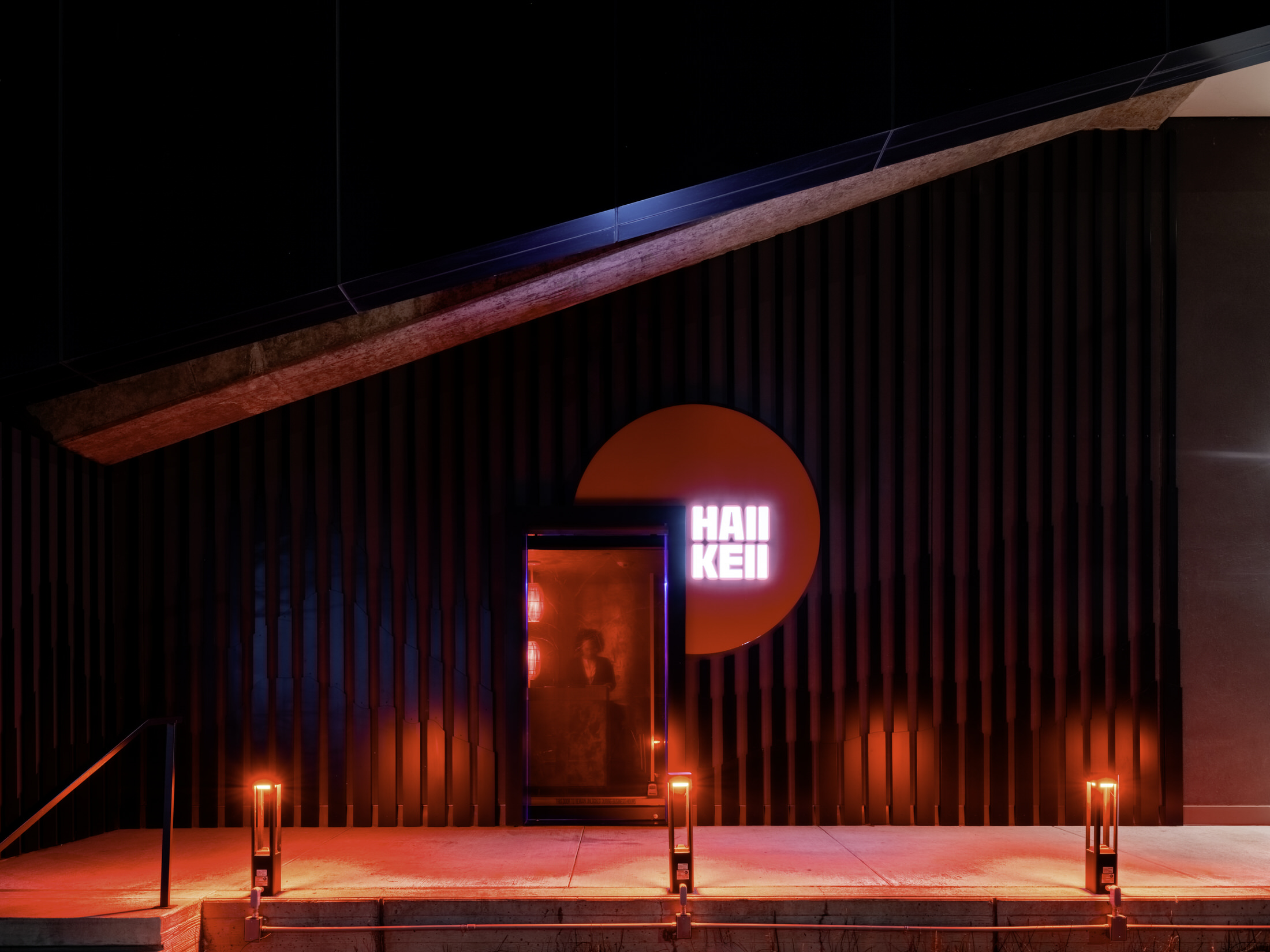
The journey begins before the first course is even served. Guests are greeted by a glowing red glass entrance, a chromatic shock that immediately severs their connection to the mundane streets of Houston. This is not a subtle transition; it is a sensory reset. As you enter, the air feels different, cooled by blue-light cascades that mimic the flicker of a futuristic metropolis.
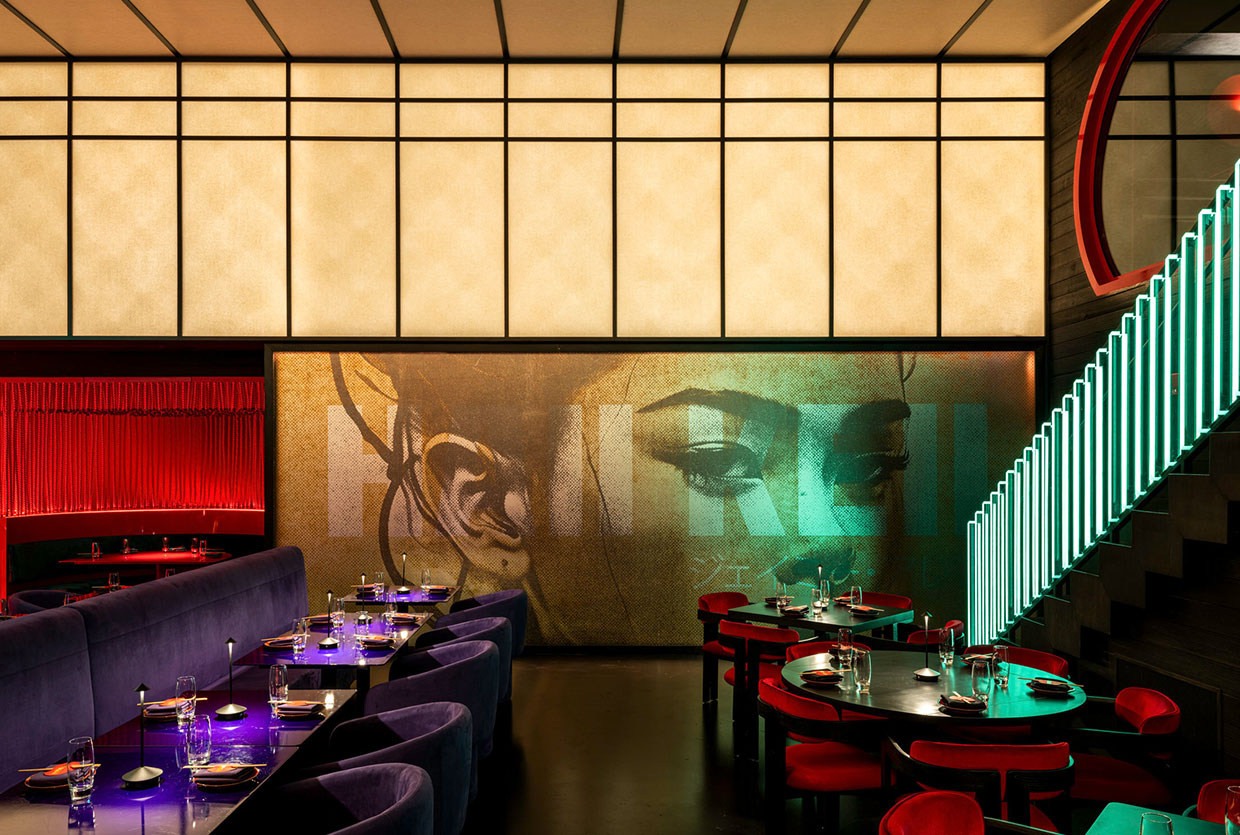
The walls themselves seem to breathe, finished in an undulating metallic plaster that catches the light in ways that suggest motion. Raydon Creative’s custom-illuminated lucite panels are integrated into the architecture, casting phosphene-like hues of deep crimson, electric green, and inky blue-purple. These colors are not decorative; they are atmospheric, designed to manipulate the guest's circadian rhythm and signal that they have entered a space where time follows different rules.
Material Alchemy: The Bar and the Inverted Bonsai
In the main dining hall, the material palette becomes a dialogue between the organic and the synthetic. This "Material Alchemy" is the signature of the Gin Design Group’s approach, blending four distinct material contrasts—shou sugi ban blocks, river rock mosaic, metallic plaster, and illuminated lucite—to simulate transitions between cinematic realities.
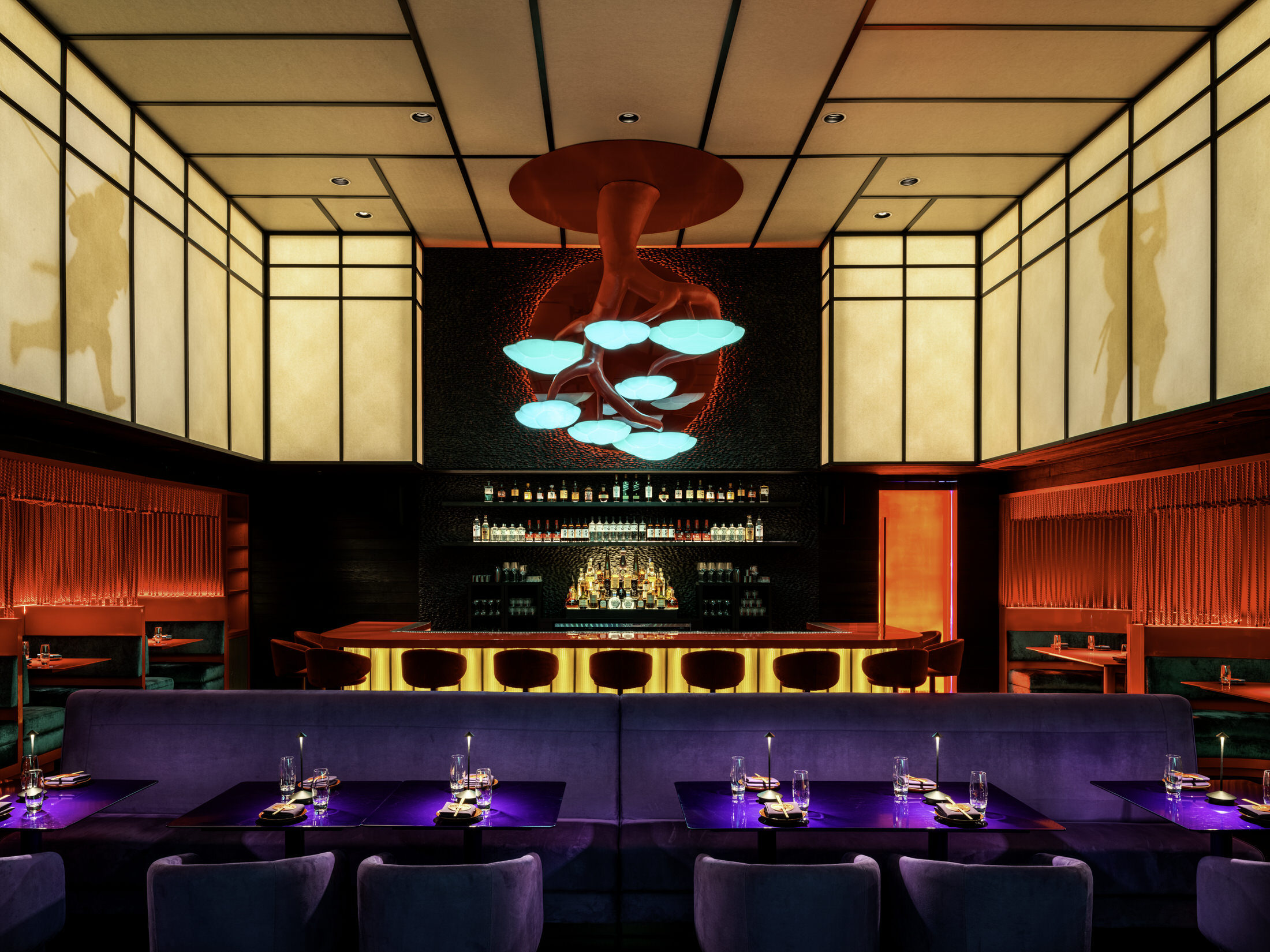
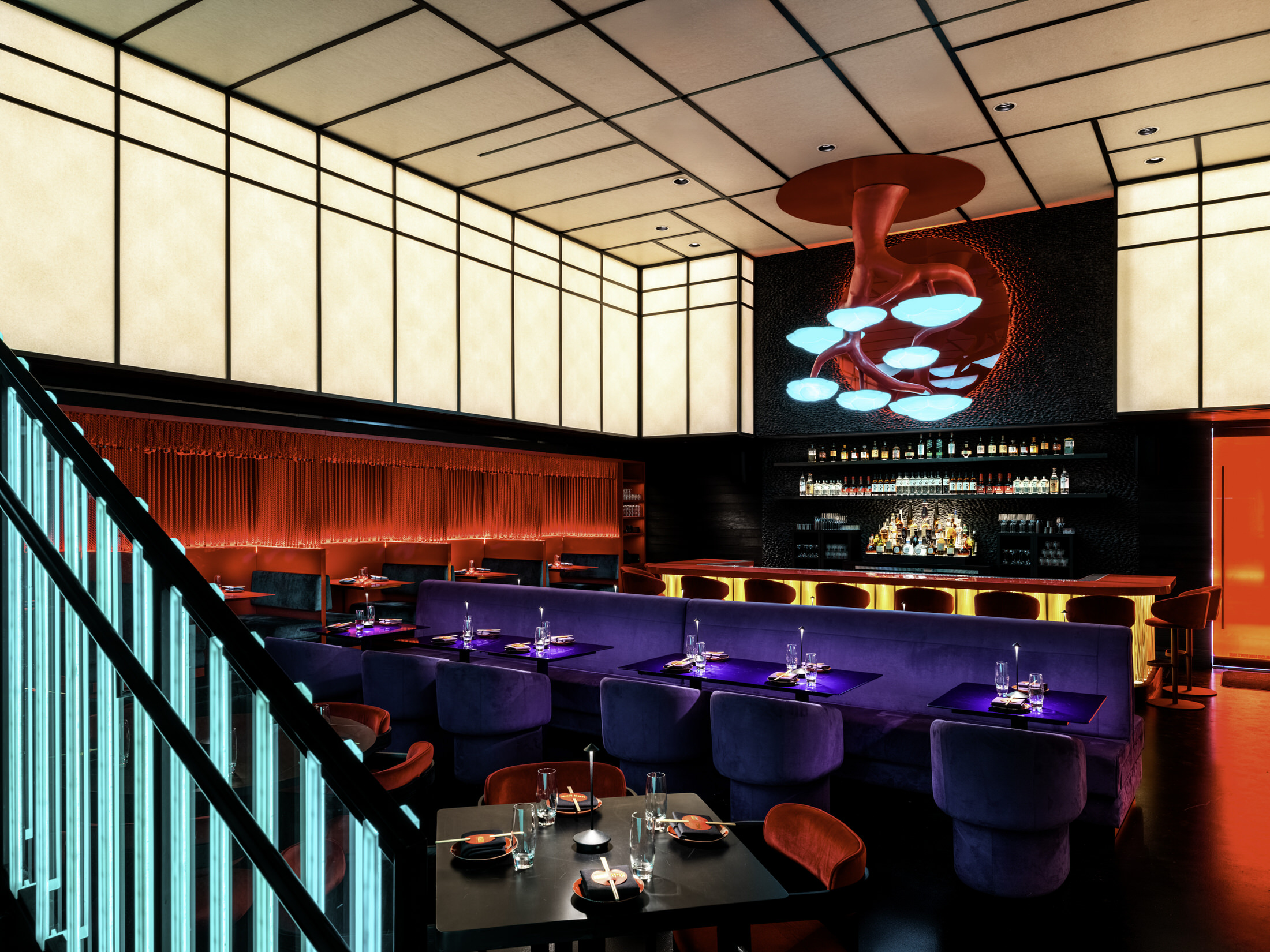
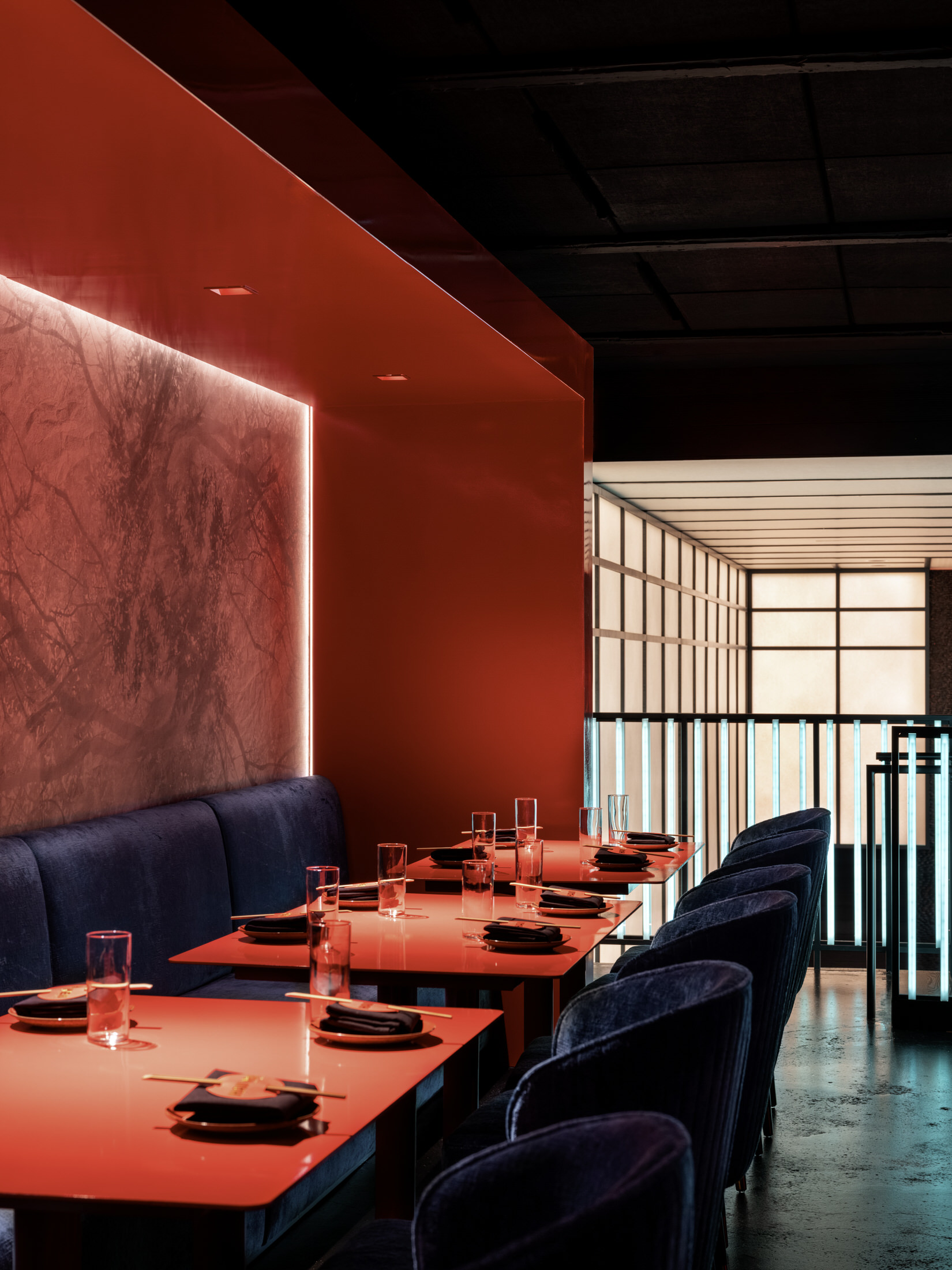
The bar area is a focal point of this experimentation. A river rock mosaic, resembling the scales of a mythical dragon, flows across the floor, met by the sharp, industrial lines of red metal tabletops. However, the true showstopper is the "Inverted Bonsai," a collaboration with the artist Moon Pappas. Suspended from a polished red disc that reflects the room like a pool of liquid mercury, the bonsai tree hangs upside down, its roots reaching toward a ceiling that feels like an infinite void. This piece serves as a visceral metaphor for the entire project: tradition, literally turned on its head.
Designer Spotlight: The Inverted Bonsai "The collaboration with Moon Pappas was essential to anchoring the surrealism of the space," notes the design team. "By inverting a symbol as ancient and revered as the bonsai, we immediately signal to the guest that the natural laws of the outside world do not apply here."
Texture and Intimacy: The Crimson Coves
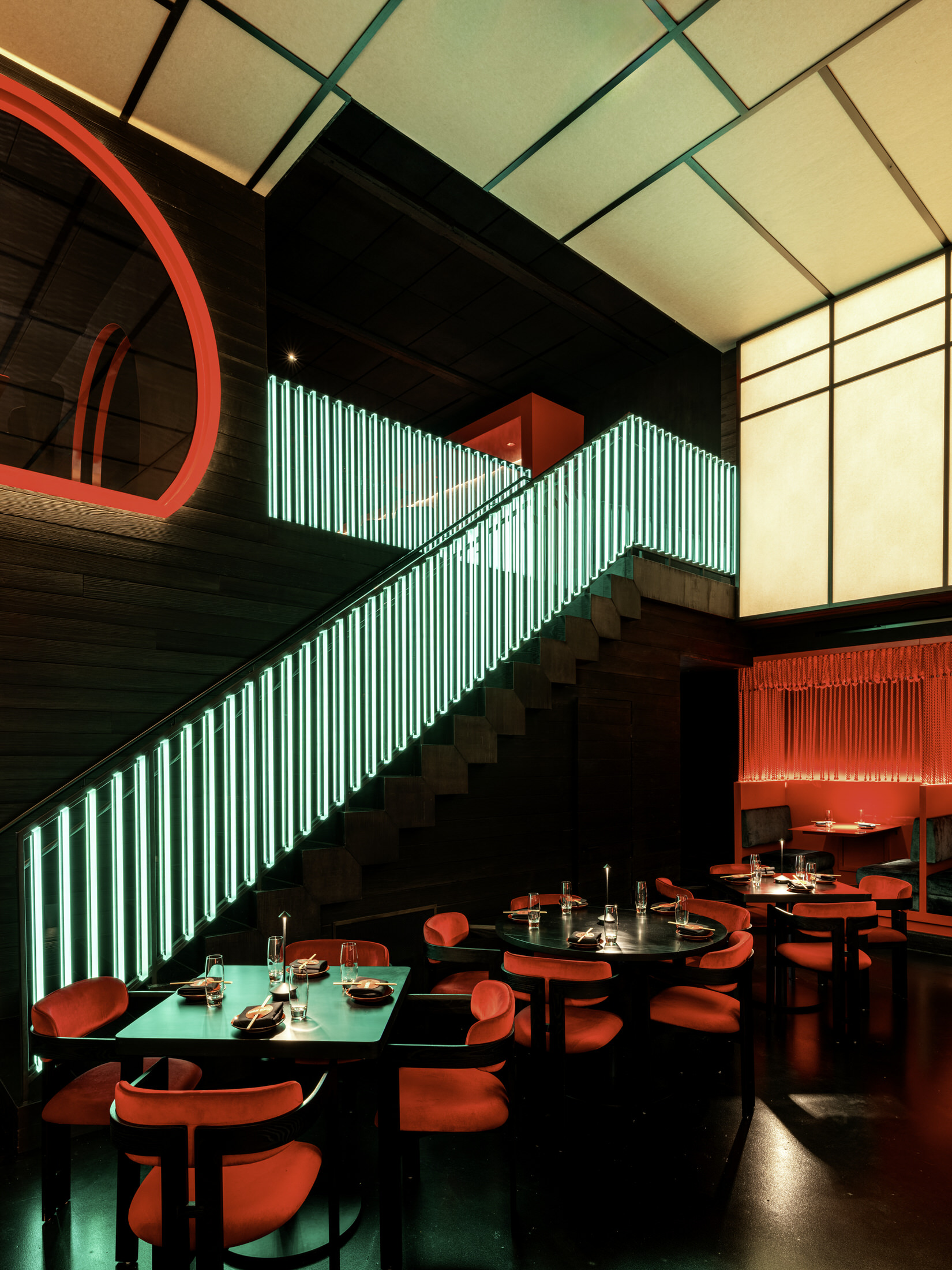
Moving deeper into the restaurant, the scale shifts from the theatrical to the intimate. One of the most technically impressive feats of the interior is the installation of the "Crimson Coves." These semi-private seating areas are defined by a massive rope art installation by Fibrous Co.
The statistics are staggering: the installation features over 4,000 linear feet (approximately 1.2 kilometers) of crimson rope. Hand-woven and tensioned to create textured screens, the rope art provides a tactile warmth that balances the colder, metallic elements of the room. These coves are designed for the "observer and the observed," a classic Tarantino-esque trope where the architecture creates sightlines that are both private and performative. The contrast is heightened by the use of turquoise banquettes—a cool-toned sanctuary amidst the sea of warm, red neon.
The Mezzanine: Ascending the Shou Sugi Ban Path
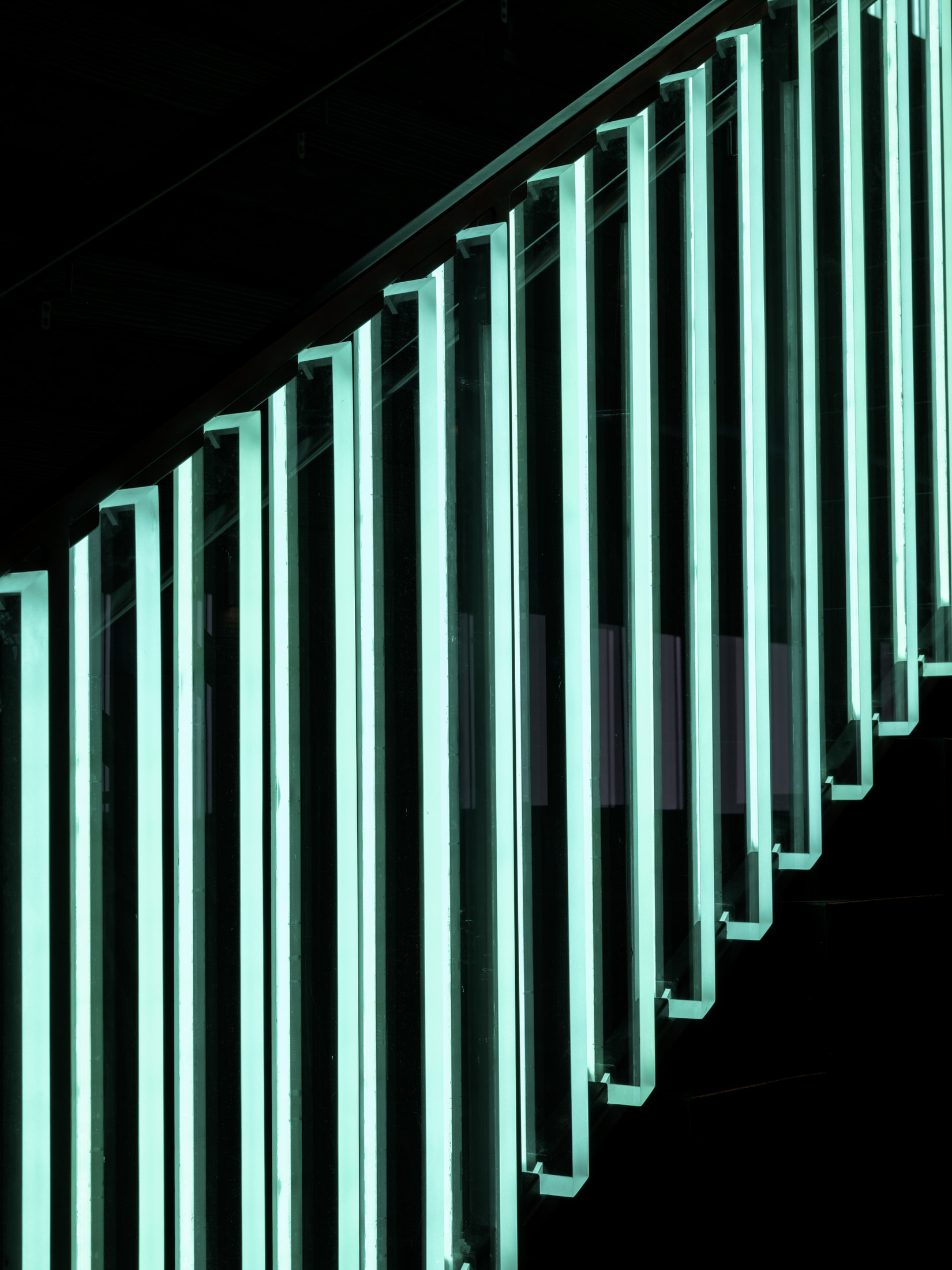
To reach the mezzanine, guests must ascend a staircase that feels like a sculptural path through a charred forest. The stairs are constructed from solid shou sugi ban blocks—a traditional Japanese technique of preserving wood through charring—which provides a deep, matte black texture that absorbs light. This is contrasted sharply by the lucite balustrades engineered by Objektfab, which appear almost invisible until they catch a stray beam of blue neon.
The mezzanine offers a panoramic view of the "theater" below, but it also houses the most exclusive dining experiences. Here, the design leans heavily into the "Moon-Gate" portals—circular floor-to-ceiling openings that connect the private dining rooms to the main energy of the restaurant.
Comparing the Contrasts: Ryokan vs. Sci-Fi
| Design Element | Traditional Ryokan Influence | Futuristic / Sci-Fi Execution |
|---|---|---|
| Woodwork | Natural Cedar / Hinoki | Charred Shou Sugi Ban & Metallic Plaster |
| Separation | Shoji Screens (Paper) | Crimson Rope Art & Lucite Panels |
| Nature | Zen Garden / Potted Bonsai | Inverted, Suspended Bonsai Installation |
| Lighting | Warm Lanterns / Sunlight | Neon-Noir, Phosphene Colors, LED Lucite |
| Circulation | Linear, meditative paths | "Moon-Gate" portals and tiered levels |
The "Moon-Gate" portals are draped in heavy black velvet, allowing for a total acoustic and visual disconnection from the main room if desired. It’s this layering—the transition from the high-energy "street" feel of the bar to the secluded, almost temple-like atmosphere of the upper level—that makes Haii Keii a masterpiece of spatial storytelling.
Why Haii Keii Defines Tomorrow’s Interiors
Haii Keii is a lighthouse for the interior trends of 2026. It moves past the "Instagrammable" moments of the early 2020s and into the realm of true sensorial immersion. By integrating biophilic evolution—represented by the Moon Pappas bonsai—with "material intelligence," Gin Design Group has created a space that feels dynamic and responsive.
The project succeeds because it doesn't just reference its inspirations; it synthesizes them into something entirely new. The intentional clash of cool turquoise and warm crimson, the 1.2 kilometers of rope, and the four distinct material transitions all work in harmony to simulate a cinematic experience. In an era where we can find anything on a screen, Haii Keii reminds us that there is no substitute for the physical, tactile, and emotional journey of a brilliantly designed space.
Frequently Asked Questions
What is the specific inspiration behind the color palette of Haii Keii? The palette is inspired by "phosphene" colors—the rings of light you see when you close your eyes tightly. This includes saturated crimsons, deep teals, and electric purples, which mimic the cinematic lighting found in neon-noir films like Blade Runner 2049.
How does the rope art contribute to the dining experience? Beyond its visual impact, the 4,000 linear feet of crimson rope by Fibrous Co acts as a soft architectural divider. It provides acoustic dampening, making the "Crimson Coves" feel private and quiet despite being in a high-energy, communal restaurant.
What is 'Shou Sugi Ban' and why was it used here? Shou sugi ban is a traditional Japanese method of charring wood to make it resistant to fire and pests. In Haii Keii, it is used for its deep, charcoal-black texture, providing a grounding, organic contrast to the high-tech lucite and metal elements.
Are you ready to redesign your own space with a touch of the surreal? Whether you're looking for a cinematic home bar or a serene, ryokan-inspired bedroom, blending high-contrast materials is the key to a 2026-ready interior. Stay tuned for our next feature on "Material Intelligence" in residential design.