Quick Facts
- Artist: Studio Drift (Lonneke Gordijn and Ralph Nauta)
- Installation: Meadow, a site-specific kinetic light sculpture
- Location: Milwaukee Art Museum, Windhover Hall
- Dates: Now through April 13, 2025
- Admission: Free for all visitors for this specific installation
- Primary Materials: Aluminum, stainless steel, robotic components, and integrated LED lighting
- Technical Core: Robotic nictinasty (mimicking the biological sleep movements of plants)
- Significance: The second iteration of the MAM Winter Series focused on public well-being
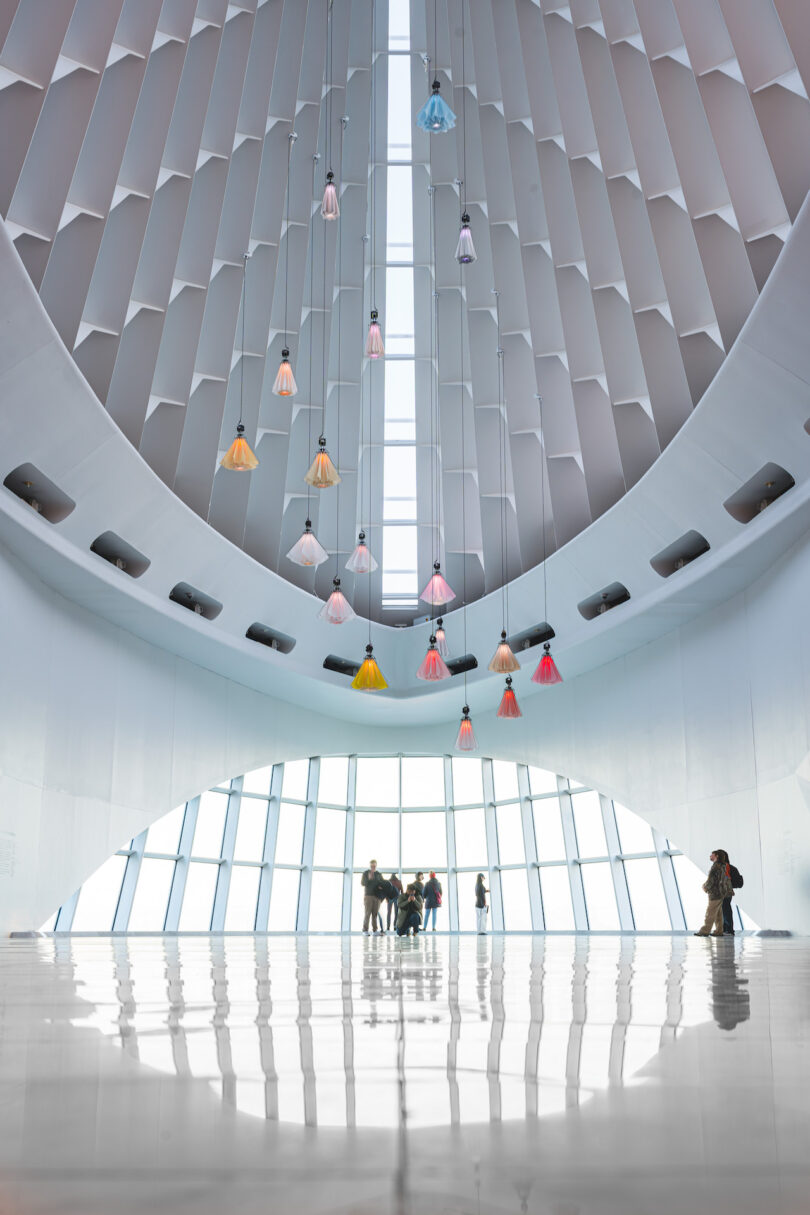
As the freezing winds of Lake Michigan whip against the stark, white ribs of the Quadracci Pavilion, a different kind of life is blooming inside. Entering the Milwaukee Art Museum’s Windhover Hall this winter feels less like stepping into a gallery and more like stumbling into a high-tech sanctuary. Above, suspended from the soaring glass ceiling, eighteen oversized, robotic flowers descend and ascend in a rhythmic, hypnotic breath. This is Meadow, an immersive kinetic light sculpture by the Amsterdam-based Studio Drift that is currently redefining the intersection of nature, technology, and public space in Wisconsin.
The Art of Robotic Nictinasty: How DRIFT Redefines Motion
To understand why Meadow is so captivating, one must understand the biological concept that inspired it: nictinasty. In the botanical world, nictinasty is the circadian rhythmic movement of higher plants in response to the onset of darkness—the way a flower petals fold inward at night to protect its pollen and reopen with the first touch of dawn.
Studio Drift has spent years of multi-year research to perfect what they call "robotic nictinasty." This isn't just a mechanical loop; it is a sophisticated fusion of engineering and organic observation. The installation at the Milwaukee Art Museum represents a pinnacle of this research, where the "flowers" are programmed with an autonomous choreography. Using a complex system of sensors and robotic components, the sculptures perform an ever-changing dance.
The construction of these kinetic sculptures is a feat of modern engineering. Each unit is built from a combination of lightweight aluminum and stainless steel, ensuring the structural integrity needed for continuous movement while maintaining the delicate, ethereal appearance of a wildflower. The "petals" are crafted from a specialized fabric that catches the light, glowing from within via integrated LEDs that shift in hue as the flowers bloom and retract.
"Our work is an attempt to reconnect humans with the rhythms of nature through the very thing that often alienates us from it: technology. Meadow is a living organism made of steel and code." — Studio Drift Curatorial Note
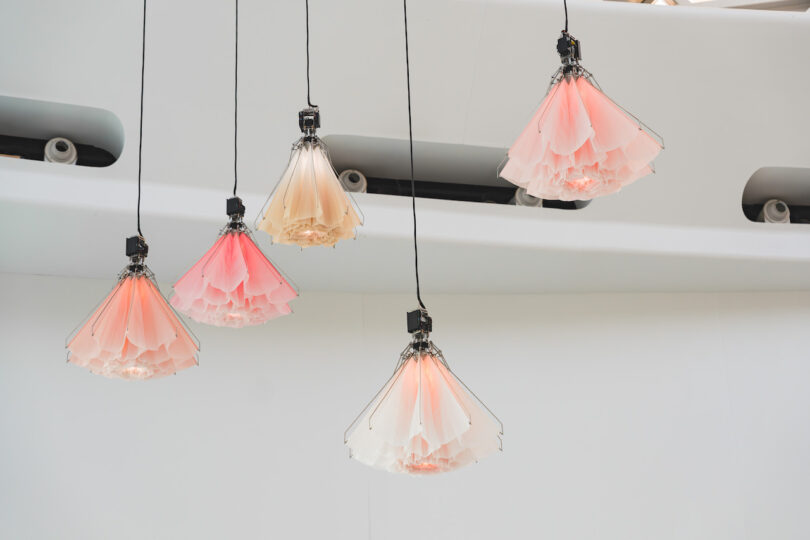
Site-Specific Brilliance: 18 Flowers in a Glass Cathedral
While Meadow has been exhibited in various forms around the world, the Milwaukee iteration is entirely unique. Studio Drift meticulously designed the installation to respond to the specific architecture of Santiago Calatrava’s Quadracci Pavilion. The 18 suspended flowers are not just placed in the room; they are in a constant dialogue with the "bird on the lake" architecture.
For the Milwaukee Art Museum Winter Series 2025, the artists developed a site-specific color palette and choreography inspired by North American wildflowers. The soft gradients of pinks, oranges, and deep violets mirror the flora one might find in a Wisconsin prairie during the height of summer, creating a poignant contrast to the monochromatic white and grey of a Milwaukee winter.
| Technical Specification | Detail |
|---|---|
| Quantity | 18 individual kinetic units |
| Suspension | Variable heights ranging from 10 to 30 feet |
| Lighting | Integrated RGB LED systems with custom diffusion |
| Movement | Independent robotic winches with synchronized software |
| Color Palette | Custom North American Wildflower Spectrum |
Installing a kinetic meadow under a moving glass and steel roof presented significant technical hurdles. The team had to coordinate the suspension of the robotic units with the museum's iconic Burke Brise Soleil—the massive "wings" that open and close daily. The result is a seamless integration where the mechanical movement of the building and the artistic movement of the installation feel part of the same heartbeat.
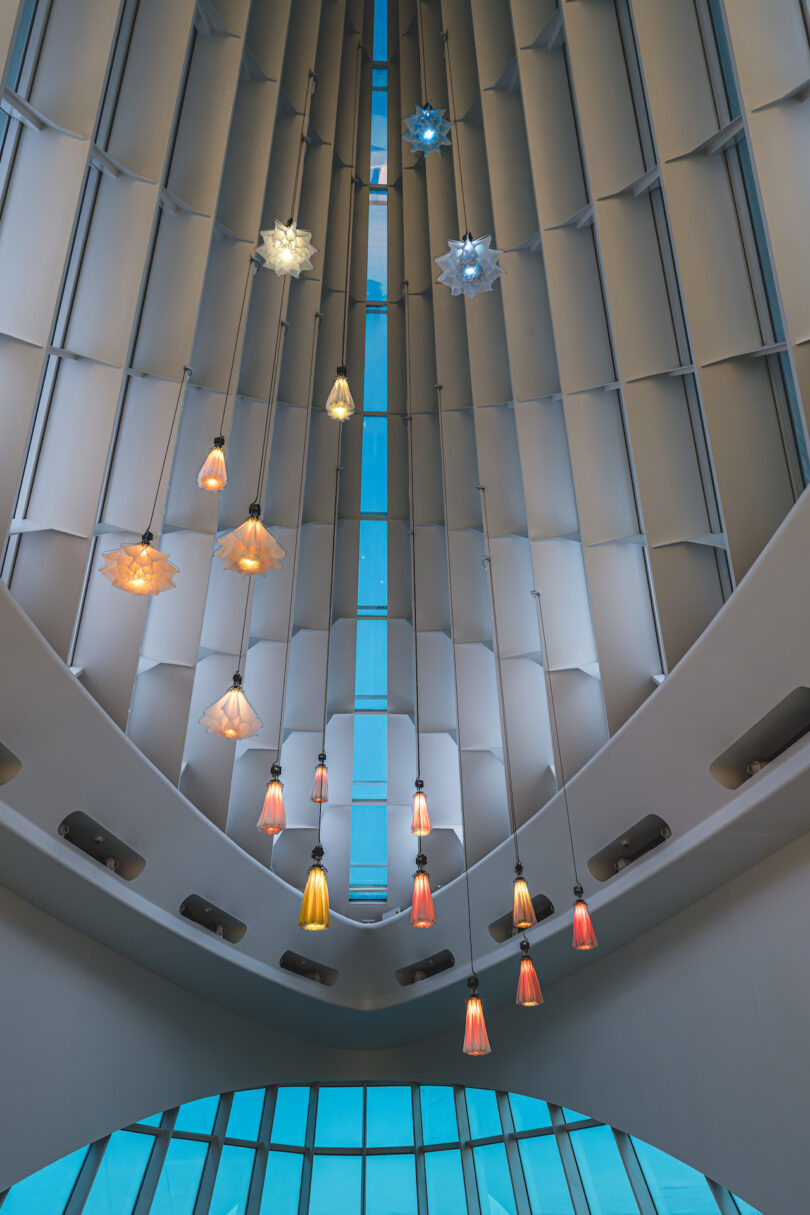
More Than Art: The MAM Winter Series Initiative
Meadow serves a purpose beyond mere aesthetic beauty. It marks the second iteration of the Milwaukee Art Museum’s official Winter Series, a social and wellness initiative launched in 2024. The program was designed specifically to combat the "winter blues" or Seasonal Affective Disorder (SAD) by providing a space of warmth, light, and "awe" during the shortest, darkest days of the year.
Statistics from the museum's inaugural 2024 series showed a marked increase in community engagement, prompting the museum to double down on immersive experiences that prioritize public well-being. By offering free admission to Windhover Hall for the duration of the installation, the museum has turned its most prestigious architectural space into a communal living room for the city.
The social mission of Meadow is evident in how visitors interact with the space. You will see people lying on the floor directly beneath the flowers, looking upward as the fabric expands and contracts. The repetitive, rhythmic pulsing of the light has a documented "calming effect," similar to the sensation of watching waves hit the shore. It is art as a public service—a high-tech intervention against the isolation of winter.
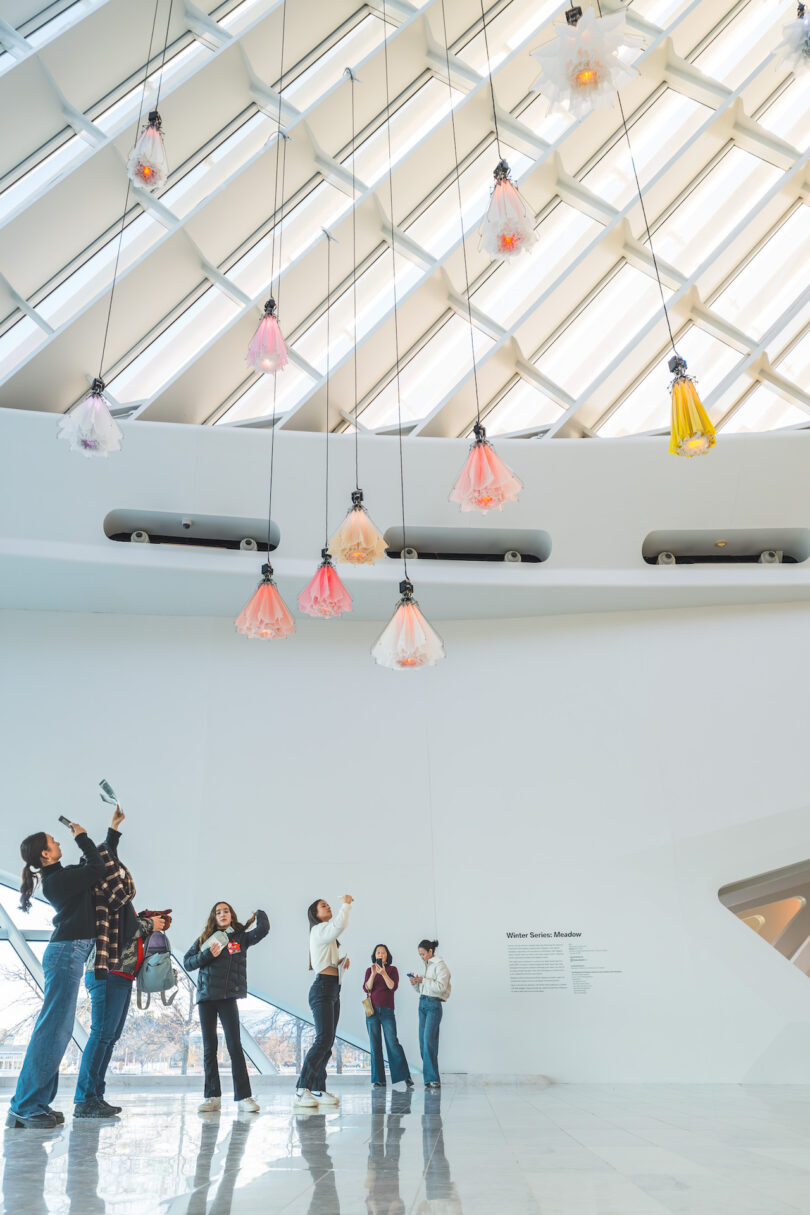
The Immersive Experience: Light, Motion, and Shadows
Perhaps the most magical aspect of Meadow is how it transforms throughout the day. Because Windhover Hall is essentially a "glass cathedral," the installation is at the mercy of the shifting Wisconsin sky.
- Morning: As the sun rises over Lake Michigan, the natural light pierces through the glass, making the translucent fabric of the flowers look like stained glass.
- The Noon "Flap": When the museum’s wings (the Brise Soleil) move at noon, the shadows cast over Meadow shift dramatically. The interplay of mechanical shadows from the building and the kinetic movement of the flowers creates a layered, cinematic experience.
- Dusk: This is arguably the best time to visit. As the natural light fades, the internal LEDs of the sculptures take center stage, casting vibrant, pulsating glows across the white marble floors and the architectural ribs of the pavilion.
The experience is further enhanced by the acoustic qualities of the hall. The near-silent hum of the robotic winches adds a subtle, industrial undertone to the visual grace, reminding the viewer that this "nature" is a carefully constructed simulation.
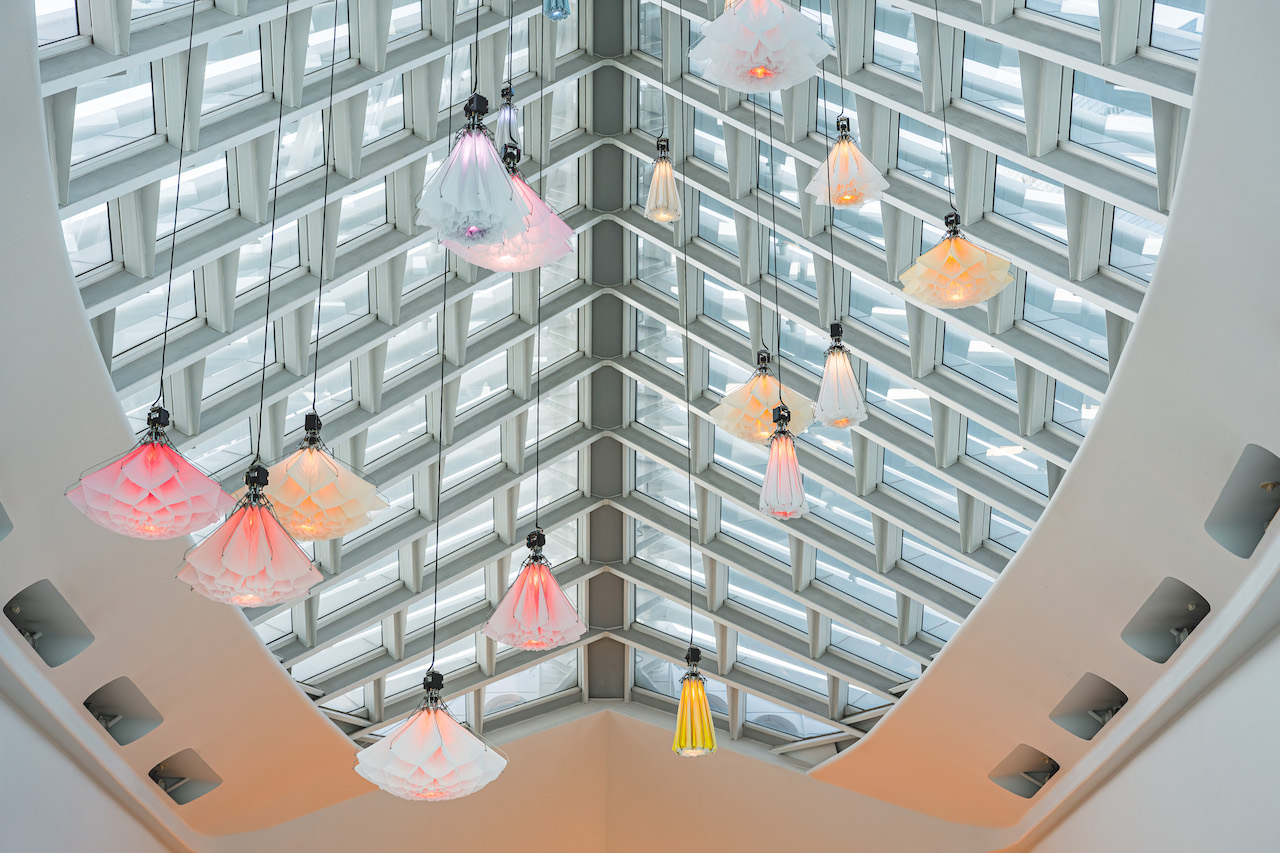
Planning Your Visit
If you are planning to experience DRIFT’s Meadow at the Milwaukee Art Museum, here are the essential details to ensure a seamless visit:
- Timing: The installation is on view until April 13, 2025. To see the full effect of the internal lighting, try to arrive in the late afternoon as the sun begins to set.
- Cost: Admission to Windhover Hall is free. If you wish to visit the permanent galleries or other special exhibitions, standard museum admission fees apply.
- Accessibility: The hall is fully accessible, and visitors are encouraged to find a comfortable spot (including sitting or lying on the floor in designated areas) to fully immerse themselves in the vertical movement of the art.
- Photography: Photos are highly encouraged, but the museum asks that visitors refrain from using flash to avoid disrupting the delicate internal LED programming of the sculptures.
FAQ
What exactly makes the sculptures move? The movement is controlled by a series of high-precision robotic winches and software. Studio Drift uses "robotic nictinasty" algorithms that ensure each flower moves independently but in harmony with the group, mimicking the way real flowers react to environmental stimuli.
Is Meadow suitable for children? Absolutely. The installation is highly engaging for children due to its scale and movement. It provides a tactile-feeling visual experience that often fascinates younger audiences, making it a perfect family outing during the winter months.
How long should I spend at the installation? While you can see the effect in a few minutes, most visitors find themselves staying for 20 to 30 minutes. The choreography is non-repeating, so the longer you stay, the more variations in light and motion you will observe.
Whether you are an art aficionado or simply someone looking for a reprieve from the Wisconsin cold, Meadow offers a rare moment of technological beauty. It is a reminder that even in the depths of winter, things can still bloom.