Quick Facts
- The Artist: Analia Saban is an Argentine-born, Los Angeles-based contemporary artist known for her "anatomical" approach to art, where she deconstructs and remakes traditional materials like paint, canvas, and marble.
- The Technique: Saban is famous for "woven paint," a process where she dries acrylic paint into long, pliable strips and weaves them into linen using a traditional loom, turning the medium into a structural element.
- The 2025 Exhibition: Her solo show, Flowchart, runs at the Tanya Bonakdar Gallery in New York (October 30 – December 18, 2025), exploring the intersection of digital logic and physical craft.
- Key Installations: The exhibition features monumental 9-foot-tall installations visualizing artistic decision-making and an 18-piece grid of laser-cut "Studio Notes."
- Material Innovation: Saban’s work bridges the gap between ancient textile history and modern computer binary code, highlighting how the loom was a precursor to the digital computer.
Imagine walking into a high-end gallery and feeling an immediate, almost primal urge to reach out and touch the canvas. Usually, the "Do Not Touch" signs in museums act as a barrier to intimacy, but in the presence of Analia Saban’s work, that barrier feels like a personal challenge to our sensory perception. Saban, an Argentine-born artist who has spent her career in Los Angeles deconstructing the very "DNA" of art materials, doesn't just paint a picture; she builds a topography. Her practice is a relentless inquiry into what happens when you strip an object of its traditional function and reconstitute it as something entirely new. Whether it is marble carved to look like a puffer jacket or acrylic paint woven like wool, Saban’s work demands that we "get closer"—not just to see the image, but to understand the physical labor of its birth.
The Innovation of 'Woven Paint': Medium as Structure
The most striking innovation in Saban’s repertoire is her radical reimagining of the relationship between paint and canvas. In traditional art history, the canvas is the support and the paint is the decoration. Saban flips this hierarchy on its head. She treats paint as a structural component, literally interlacing it with the fabric that was once meant to hold it.
The technical process is as rigorous as it is poetic. Saban begins by drying long strips of acrylic paint—often referred to in her studio as "snakes"—until they reach a specific level of pliability. These strips are then taken to a traditional floor loom. Here, Saban replaces the traditional "weft" (the horizontal threads) with these strips of dried paint. As the loom clacks back and forth, the paint is woven directly into the linen "warp" (the vertical threads).
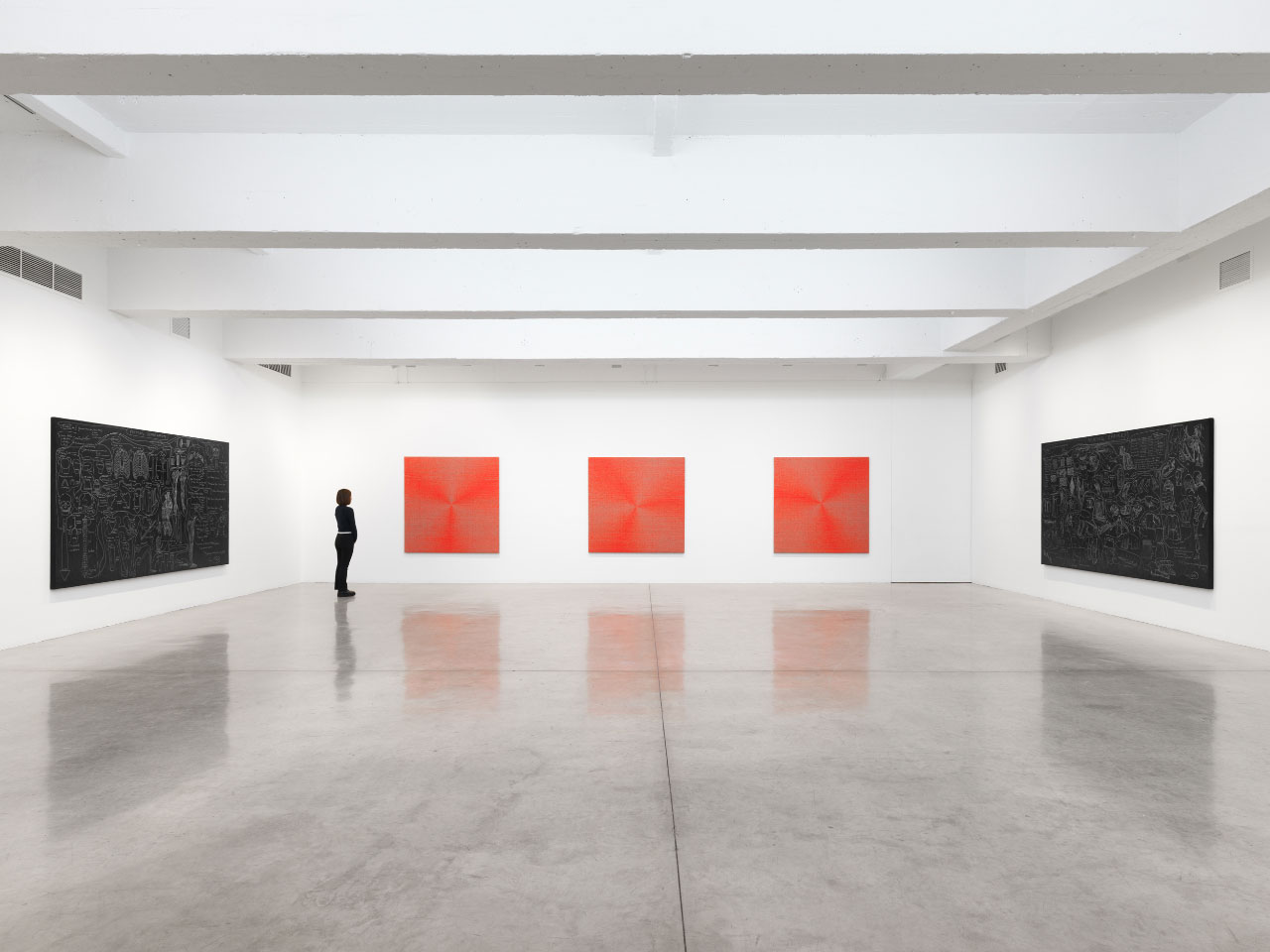
The result is a material hybrid. In works like the Woven Three-Blade Fan (Fluorescent Orange), the vibrant, synthetic color of the paint isn't just sitting on the surface; it is the surface. This technique breaks the binary between the medium and the structure. By turning paint into a thread, Saban asks us to reconsider the physical limits of the liquid. The fluorescent hues often used in these series serve as a nod to digital heat and energy, suggesting that even our most "analog" crafts are inextricably linked to the high-voltage logic of the modern world.
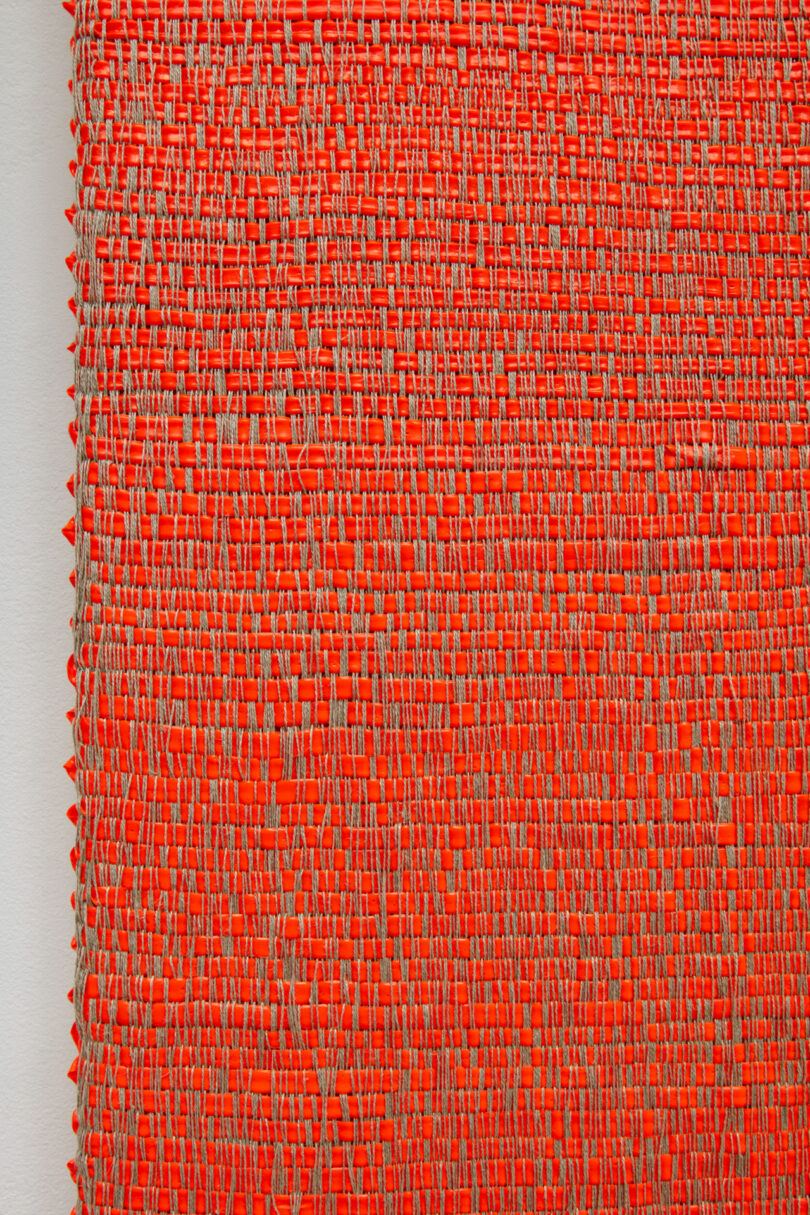
Traditional Painting vs. Saban’s Deconstructed Painting
| Feature | Traditional Painting | Saban’s Deconstructed Painting |
|---|---|---|
| Medium Role | Paint is applied to a surface. | Paint is the surface. |
| Material State | Liquid dried onto a solid. | Solid "snakes" woven into a grid. |
| Visual Depth | Created through perspective/layering. | Created through physical texture and weaving. |
| Historical Root | Renaissance perspective and brushwork. | Industrial loom technology and binary code. |
| Relationship | Canvas supports the paint. | Paint and linen are structurally interdependent. |
Inside the 'Flowchart' Exhibition (2025)
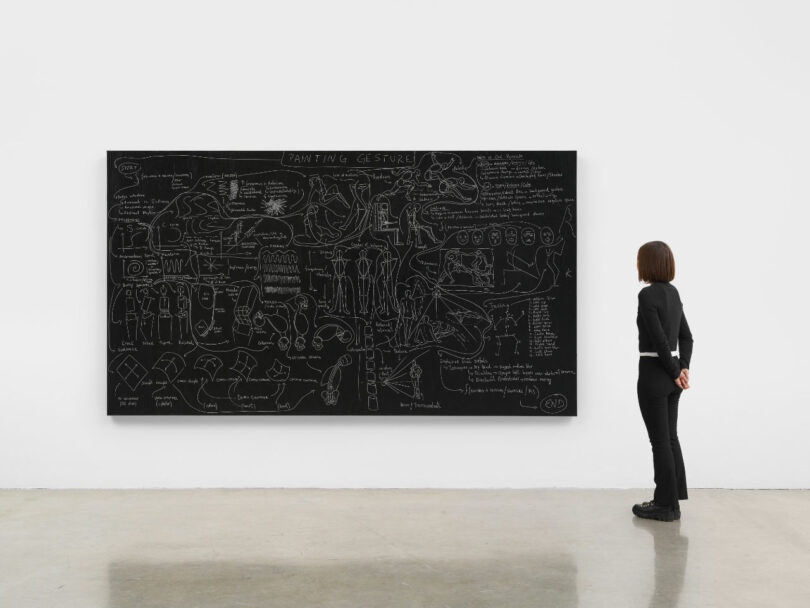
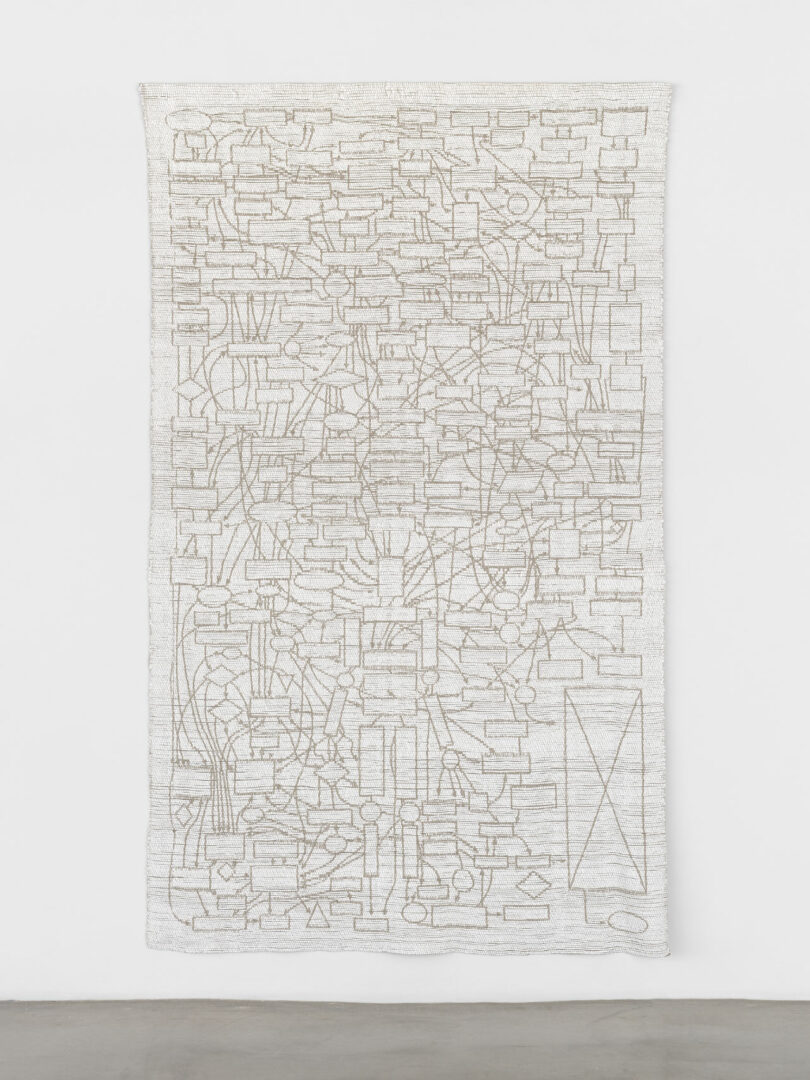
Opening at the Tanya Bonakdar Gallery in New York in late 2025, the Flowchart exhibition marks a significant evolution in Saban’s career. The show is titled after the diagrams used in computer programming and business management to visualize a sequence of steps. For Saban, the "flowchart" is a metaphor for the artistic process—a series of "if/then" decisions that lead to the final work.
The scale of the exhibition is designed to overwhelm the senses. Several monumental installation pieces stand over 9 feet tall, effectively turning the gallery into a cathedral of logic. These large-scale works utilize the visual language of university-scale chalkboards, but instead of chalk dust, they are rendered in complex textures that map out the internal logic of artistic production.
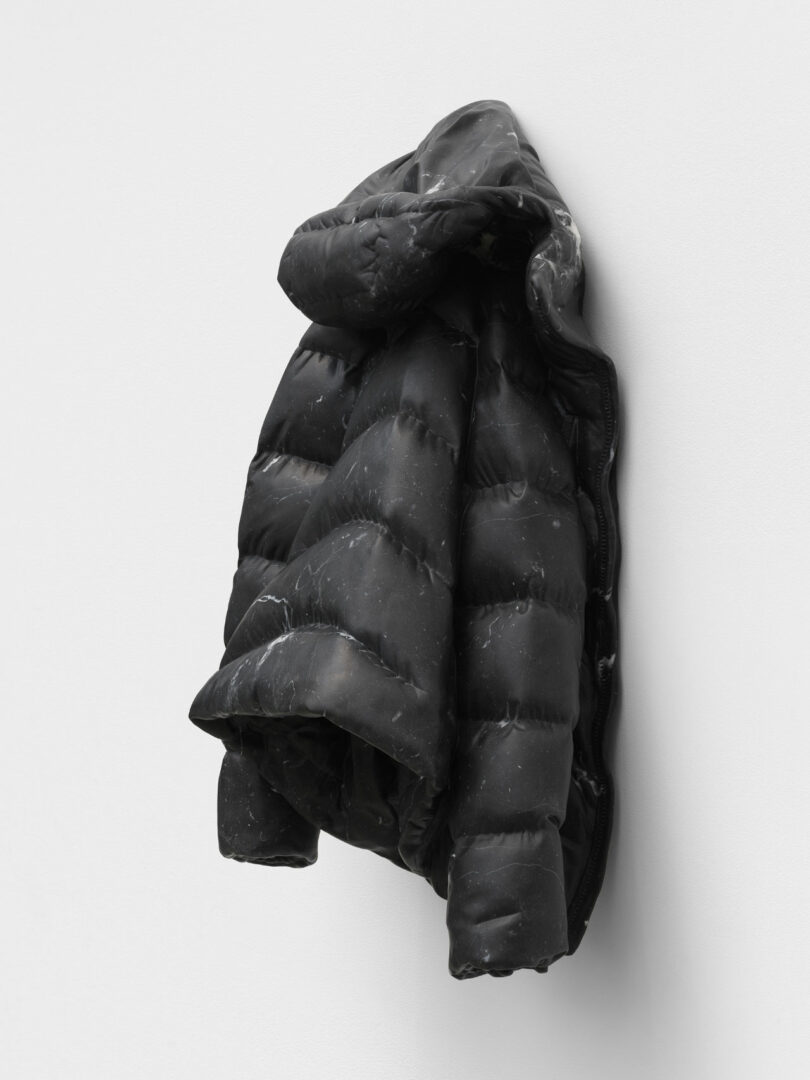
One of the most talked-about pieces in the 2025 show is Puffer (Patagonia, Nero Marquina). In this sculpture, Saban takes the concept of material subversion to the extreme. She uses a combination of high-precision robotic carving and meticulous hand-finishing to transform a block of Nero Marquina marble into what appears to be a soft, quilted Patagonia puffer jacket.
"I'm interested in the moment an object loses its intended function and becomes a pure material inquiry," Saban has noted. "When marble—the most permanent of materials—mimics the fleeting, soft texture of a nylon jacket, it creates a friction that forces the viewer to question their own eyes."
The Flowchart series doesn't just present the finished object; it presents the decision-making behind it. By using the visual language of diagrams, Saban invites the viewer into the "studio brain," where every brushstroke or material choice is a node in a vast, interconnected network.
Studio Notes and Laser-Cut Precision
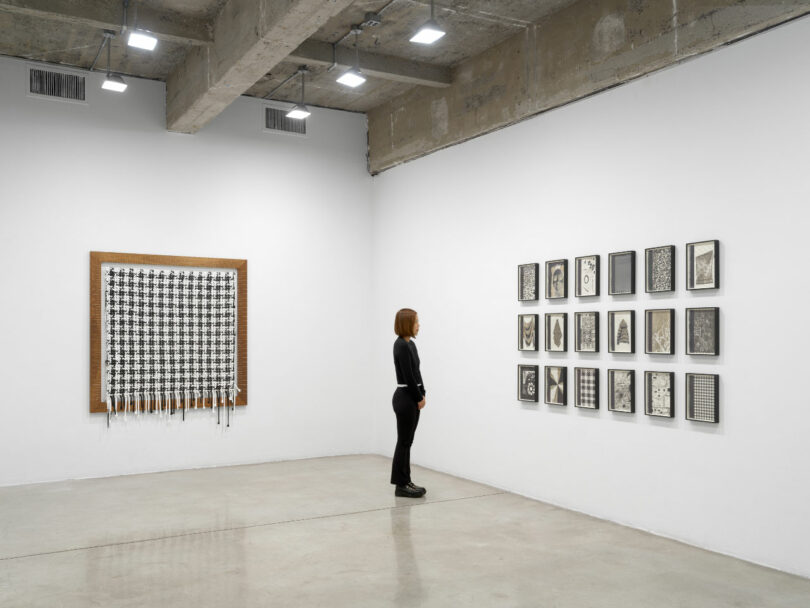
While the large-scale installations capture the grandeur of the exhibition, the "Studio Notes" series offers a more intimate look at Saban's obsession with variables. This 18-piece grid is a masterclass in material friction.
Using standard notebook paper as her "canvas," Saban employs high-precision laser-cutting technology to explore the physical limits of the material. Instead of simply drawing on the paper, she uses the laser to "toast" the fibers or cut through them entirely, creating patterns that mimic graphite lines but possess a three-dimensional depth.
- The Grid: An 18-piece sequence that tests how much "stress" paper can take before it disintegrates.
- The Medium: A blend of traditional graphite and "burnt" paper edges, creating a monochrome palette of blacks, greys, and seared browns.
- The Logic: Each piece represents a different "variable" in drawing—pressure, speed, heat, and depth.
By using a laser—a tool of modern industry—to create something as humble as a "studio note," Saban bridges the gap between the high-tech and the handmade. The grid formation emphasizes the scientific nature of her exploration; it is as if we are looking at a series of laboratory slides rather than traditional drawings.
The Historical Loop: Looms, Code, and Connectivity
To understand the intellectual depth of Analia Saban’s work, one must look back at her 2018 exhibition Punched Card. That show established a vital link that continues through Flowchart: the connection between the industrial loom and the modern computer.
History tells us that the Jacquard loom, which used punched cards to automate weaving patterns, was a direct ancestor of the first programmable computers. Saban taps into this "binary history." Her woven paint works are essentially physical manifestations of "zeros and ones"—the interlacing of thread (0) and paint (1).
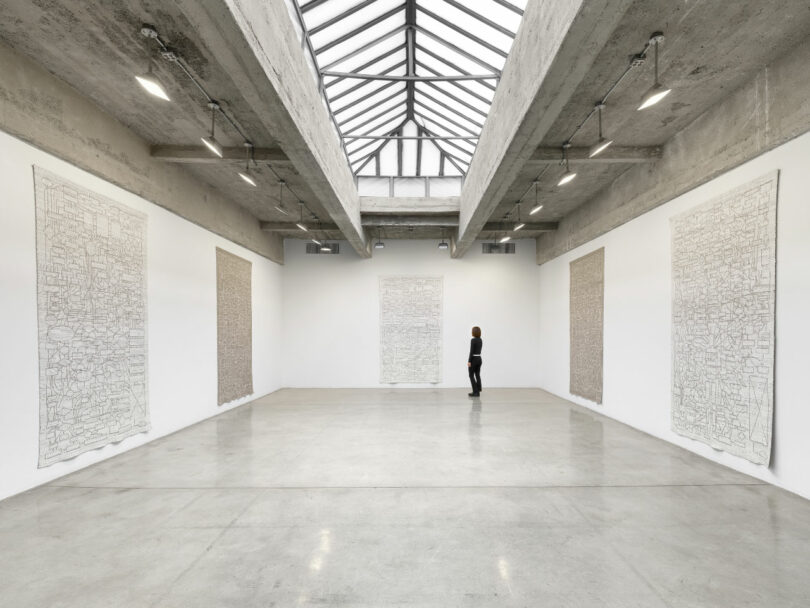
In her latest pieces, this connectivity is visualized through intricate white-on-white structures. These works often resemble computer circuit boards or motherboards, but they are rendered in the soft, tactile language of textiles. It is a stunning reversal: what looks like a digital schematic is actually a hand-woven artifact. This synthesis of histories reminds us that our "new" technology is deeply rooted in the "old" crafts of the domestic sphere.
The Experience of Texture in Modern Interiors
Why does Saban’s work resonate so strongly with contemporary collectors and interior designers? In an increasingly digital world where our primary interactions are with flat, glass screens, we are starving for tactile feedback. Textured art serves as a sensory focal point that grounds a room.
Saban’s work thrives on the interplay of light and shadow. Because her pieces are essentially three-dimensional topographies—whether it’s the ridges of the woven paint or the "toasted" craters in her paper works—they change character throughout the day. As the sun moves across a room, the shadows cast by the paint "snakes" lengthen and shift, making the artwork feel like a living, breathing entity.
Beyond mere decoration, these pieces provide an intellectual anchor for modern interiors. They tell a story of labor, history, and the deconstruction of the everyday. For those looking to move beyond the flat "image-on-the-wall" aesthetic, Saban’s material hybrids offer a sophisticated alternative that celebrates the physical world's complexity.
Conclusion
Analia Saban’s Flowchart is more than just an art exhibition; it is a manifesto on the resilience of material in a digital age. By weaving paint, carving marble into "soft" clothing, and using lasers to "draw," Saban forces us to look past the surface of things. She reminds us that even in our world of logic and algorithms, the physical touch of the loom and the weight of the stone still hold the power to move us. If you find yourself at the Tanya Bonakdar Gallery this winter, remember the artist's unspoken invitation: lean in, look closely, and let the texture speak.
FAQ
Q: Can you actually touch the "woven paint" in Analia Saban’s work? A: While the visual texture is incredibly inviting and looks tactile, standard gallery rules usually apply—meaning you shouldn't touch the art. However, Saban’s work is specifically designed to be viewed from multiple angles to appreciate the 3D relief of the dried acrylic strips.
Q: What is the significance of the name "Flowchart" for the 2025 show? A: The name refers to the logical diagrams used in computing. Saban uses it to represent the sequence of artistic decisions (if/then) that occur during the creation of a piece, treating the studio process as a series of interconnected logical steps.
Q: Is the marble in the 'Puffer' series real? A: Yes, it is authentic marble (often Nero Marquina or Patagonia). Saban uses a CNC (Computer Numerical Control) machine to handle the heavy initial carving and then finishes the intricate "fabric folds" by hand to achieve a hyper-realistic, soft appearance.