We have all been there: the high-stakes Zoom call is seconds away from starting, and you are frantically diving under your desk, wrestling with a "cable monster" that seems to have a life of its own. You’re looking for the one USB-C cord that actually delivers enough power to keep your laptop from dying mid-pitch. By the time you find it, you’re flustered, your professional veneer is cracked, and you’ve wasted precious mental energy before the work even began.
In the world of home organization, we often talk about "visual noise"—the clutter that occupies the periphery of our vision and slowly drains our cognitive resources. Cables are the ultimate source of this noise. Market analysis suggests that hybrid professionals lose an average of 10 minutes daily to cable chaos and "tech-triage." While 10 minutes sounds negligible, it compounds into roughly 60 hours of frustration per year. Conversely, professionals who utilize modular charging systems designed for mobility report a 78% increase in daily productivity, largely due to the elimination of these minor but frequent stressors.
The year 2026 marks a shift in how we define our "office." We are no longer tethered to a single mahogany desk. We operate in fluid workspaces—flexible environments where technology and furniture adapt seamlessly to our location. Whether you are moving from a dedicated home office to a sun-drenched kitchen nook, a local co-working hub, or an airport lounge, your productivity shouldn't be penalized by your proximity to a power outlet. This is where Nomad’s philosophy of "invisible customization" becomes the backbone of the modern high-performance workstation.
Why Your Setup Needs a 2026 Cable Audit
If you haven't audited your cable management since 2022, your system is likely obsolete. The shift toward higher-wattage devices and the "one-cable-to-rule-them-all" standard (USB-C PD 3.1) means that the thin, plastic cords bundled with your old devices are not just eyesores—they are bottlenecks.
A 2026 cable audit isn't just about aesthetics; it’s about performance and safety. As we move toward height-adjustable "sit-stand" desks, the "Safe Length" calculation has become critical. A standard 3ft or 6ft cable often creates tension when a desk is raised, risking damage to expensive ports or, worse, snagging a monitor and sending it crashing to the floor. The new standard for fluid flexibility is the 10ft (3m) reinforced cable, providing enough slack for movement without the "cable spaghetti" effect.
Furthermore, poor cable management leads to "electrical crosstalk," where power cables draped over data lines cause flickering monitors or slow transfer speeds. By organizing and shielding your connections, you aren't just cleaning your room; you're optimizing your data highway.
Sophie’s Insight: "Think of cable management as the 'circulatory system' of your home office. When it’s clogged, the whole body feels sluggish. When it’s fluid, you forget it’s even there."
The Nomad Collection: A Modular Ecosystem for Chaos Control
To solve the friction of fluid work, Nomad collaborated with the design studio Form Us With Love to create the Nomad Collection. This isn't just another set of chargers; it is a distilled response to contemporary work culture. The collection remedies cable chaos through a modular ecosystem of portable lamps and multi-plug hubs, allowing users to establish high-performance workstations anywhere.
Crafted from 100% recycled aluminum and hand-cast in Sweden, these pieces are designed for "aesthetic plasticity." Whether you choose the industrial matte black or the calming, nature-inspired greens, these tools support functionality without looking like "tech gear." The standout innovation is the 'Portable Lamp + Hub' concept. By integrating task lighting with high-speed power delivery, Nomad allows you to claim "third spaces"—like a dark corner of a library or a busy airport lounge—and transform them into focused sanctuaries.
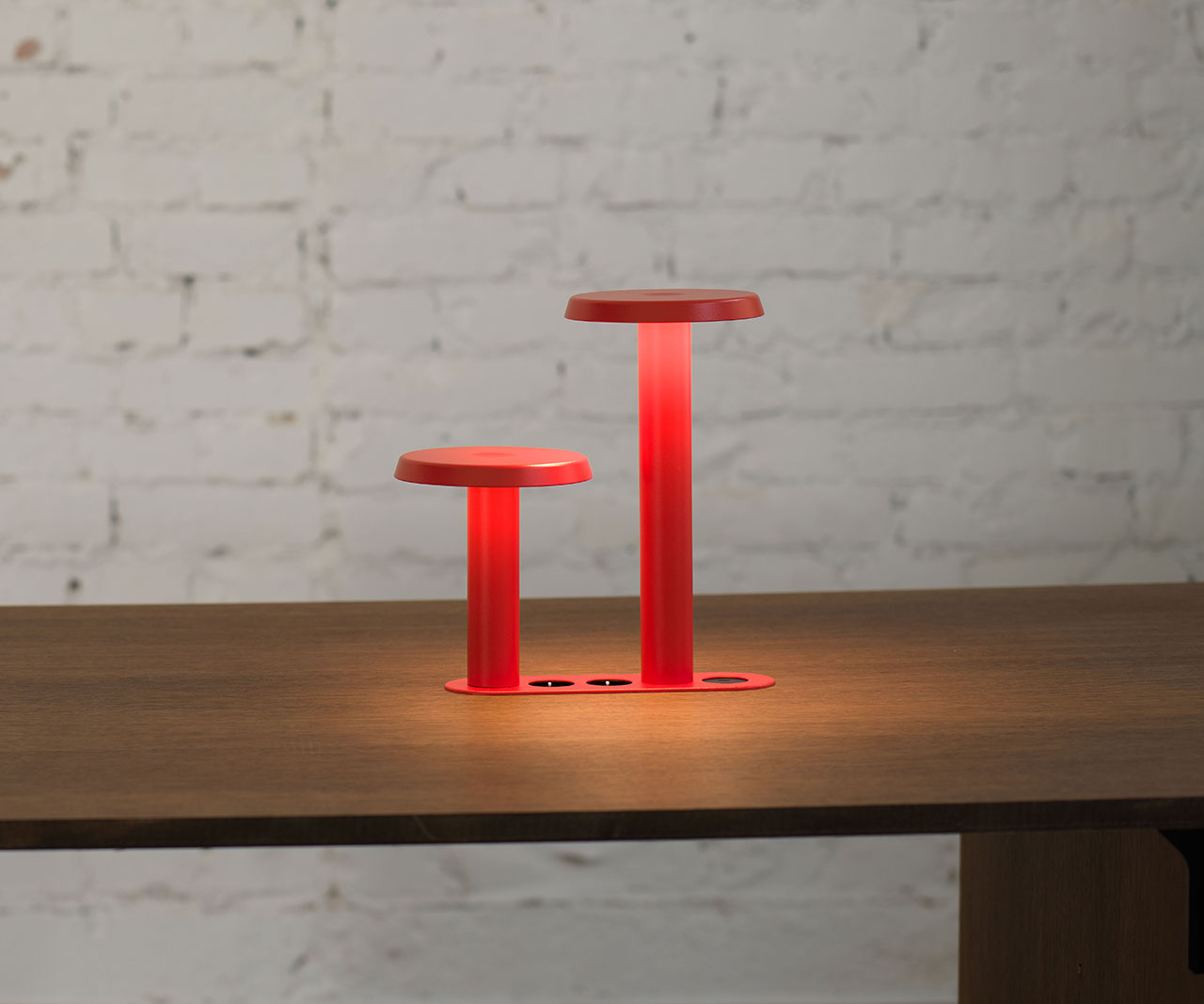
The modularity here is key. You can detach the power hub to take it on the road or dock it at your primary desk to serve as the "brain" of your setup. This eliminates the need for redundant chargers, supporting a minimalist lifestyle that values quality over quantity.
Review: The Nomad Universal Cable (The 'One Cable' Rule)
If I could recommend only one upgrade for a fluid workspace, it would be the Nomad Universal Cable. My organization philosophy always comes back to the "One Cable" rule: if a single tool can perform three tasks, you’ve just eliminated 66% of your clutter.
The 2026 iteration of the Universal Cable is future-proofed with 240W Power Delivery (PD). This is a technical milestone; it means one cable can charge everything from a high-performance 140W MacBook Pro to a 2026-gen mobile device or even a portable monitor.
- Durability: Wrapped in double-braided Kevlar with electroplated metal housings, these cables are essentially "bombproof." In a fluid workspace where cables are frequently coiled, uncoiled, and shoved into bags, this durability is a necessity, not a luxury.
- The Minimalist’s Choice: While the 3m version is great for the home office, the 0.3m (1ft) version is the travel essential. It prevents the dreaded "cord tangle" inside your laptop sleeve.
- Integrated Adapters: The genius lies in the integrated, tethered USB-A and Micro-USB adapters. Even as the world moves to USB-C, we all have that one legacy device (a camera, an old kindle, a specific mouse) that usually requires a separate cord. The Universal Cable keeps those connections attached so you never have to hunt for a dongle again.
| Feature | Nomad Universal Cable (2026) | Standard Plastic Cables |
|---|---|---|
| Max Power Output | 240W (PD 3.1) | 60W - 100W |
| Material | Double-Braided Kevlar | PVC / TPE Plastic |
| Durability Rating | 10,000+ Bend Cycles | 1,000 - 2,000 Bend Cycles |
| Sustainability | Recycled Metal / Long-lifespan | Virgin Plastic / Disposable |
| Versatility | 3-in-1 Integrated Tips | Single Connector |
Step-by-Step: Implementing 'Invisible Customization'
Creating a fluid workspace isn't about hiding every wire; it’s about Invisible Customization—ensuring that only the cables you are currently using are visible, while the rest are managed behind the scenes.
Step 1: Inventory and 'Service Loop' Creation
Before buying any organizers, unplug everything. Group your cables by "Permanent" (monitors, desktop speakers) and "Fluid" (laptop charger, phone cable). When rerouting cables, always leave a Service Loop—roughly 6-8 inches of slack near the plug. This prevents tension on the ports and allows you to move devices slightly without unplugging them.
Step 2: Under-Desk Integration
The floor should be a "no-cable zone." Mount your power strips to the underside of your desk using heavy-duty adhesive or screws. This eliminates "vampire draw" (the energy wasted by unused chargers left plugged in) by making it easier to see and manage what’s active.
Step 3: Desktop Organization
The goal of a 2026 desk is to have only one power cable visible. Use magnetic cable holders at the edge of your desk to keep your primary charging tips from falling behind the furniture. Universal docks and Nomad's modular hubs act as a single point of entry for all your peripherals, meaning a single USB-C cord is all that connects your laptop to your entire ecosystem.
Step 4: Color-Coding for Troubleshooting
Use small, discreet colored bands to map your cables. Power cables get one color, data cables another. If your monitor suddenly goes dark, you won't have to trace five identical black cords back to the power strip; you'll know exactly which one to check.
Productivity Math Call-Out
- The Cost of Chaos: 10 mins/day searching for cables = 60 hours/year lost.
- The Nomad ROI: A 15% increase in daily focus by removing visual distractions.
- The Result: You gain back nearly two full work weeks of time every year just by organizing your wires.
The Sustainability ROI: Beyond Aesthetics
In 2026, organization isn't just about personal peace; it’s about planetary impact. The electronics industry is a major contributor to global waste, but our workspace choices can mitigate this.
Transitioning to 100% recycled aluminum accessories, such as those in the Nomad Collection, can reduce a personal office’s electronic carbon footprint by approximately 45% over five years. This is because aluminum is infinitely recyclable, and the "bombproof" Kevlar materials used in Nomad cables prevent the "buy-and-toss" cycle of cheap plastic alternatives.
When you invest in a $35–$50 high-quality cable, you aren't just buying a cord; you're preventing five plastic cables from ending up in a landfill. It’s a shift from "disposable tech" to "legacy tools."
2026 Gear Ranking: Cable Trays vs. Magnetic Organizers
To help you decide which system fits your fluid workspace, here is how the top solutions rank for the current year:
| Tool Type | Best For... | Mobility Score | Setup Effort |
|---|---|---|---|
| Under-Desk Cable Tray | Permanent home offices with multiple monitors. | Low | High (Requires drilling) |
| Magnetic Cable Holders | Minimalist desks and "hot-desking" setups. | High | Low (Peel and stick) |
| Nomad Modular Hubs | Fluid workspaces (Home/Cafe/Travel). | Highest | Medium (System-based) |
| Velcro Cable Ties | Managing bundles behind the PC. | Medium | Low |
FAQ
Q: Is 240W charging safe for my older phone? A: Absolutely. Modern Power Delivery (PD) technology is "smart." The cable and charger communicate with your device to provide only the maximum wattage the device can safely handle. Using a 240W cable for a 20W phone is perfectly safe and actually runs cooler, extending the life of the cable.
Q: How do I prevent my cat/dog from chewing through these cables? A: This is where Nomad’s Kevlar braiding shines. While no cable is entirely "pet-proof," the industrial-grade aramid fibers are significantly more resistant to abrasions and biting than standard PVC.
Q: Do I really need a 10ft cable? A: If you use a sit-stand desk, yes. A 6ft cable might reach while you are sitting, but once the desk is at full standing height, that cable becomes a tripwire. 10ft (3m) is the professional standard for fluid movement.
Closing Thoughts: Reclaim Your Calm
Mastering a fluid workspace isn't about achieving a "Pinterest-perfect" desk that looks like no one works there. It’s about creating a system that serves you, rather than you serving the system. By adopting the "invisible customization" of the Nomad Collection, you’re not just managing cables—you’re managing your focus.
The next time you open your laptop, let it be in a space that feels intentional, sustainable, and entirely under your control. The "cable monster" doesn't have to be a part of your 2026 story.