“I hallucinate and dream of a world... where every square centimeter deserves our love.” These are the words of Marcel Wanders, the "Lady Gaga of Design," whose work has long challenged the sterile, minimalist "white-cube" aesthetic of the 21st century. In Budapest, a city already heavy with the gravitas of history and the ghosts of empires, Wanders has found his latest canvas. The Kimpton BEM Budapest is not merely a hotel; it is a cinematic, maximalist fever dream that serves as the brand’s high-octane debut in Eastern Europe.
By merging the skeletal remains of the 19th-century Radetsky Barracks with a vibrant, folklore-heavy interior narrative, Wanders has created a space that feels like an ethnographic immersion. It’s a design that doesn't just ask for your attention—it demands your emotional surrender.
A Transformed Landmark: The Legacy of Radetsky Barracks
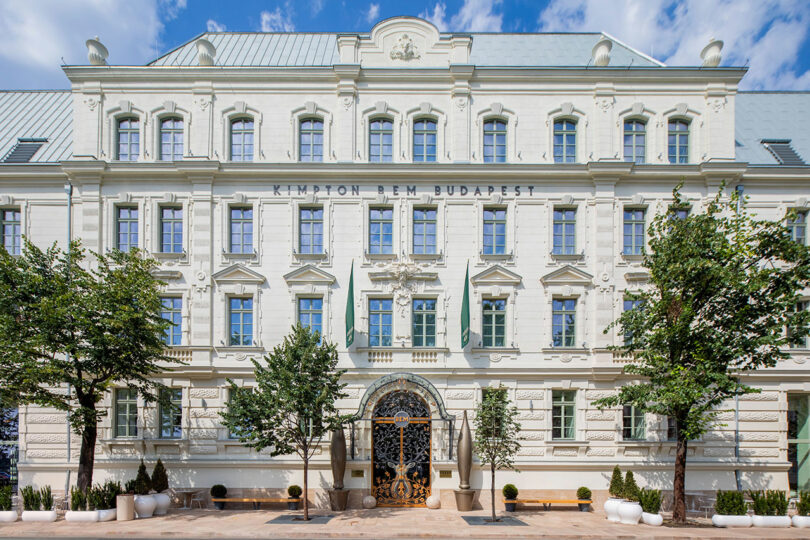
The story of Kimpton BEM begins with its shell. Situated on the quieter, more residential Buda side of the Danube, the hotel occupies a meticulously restored 19th-century palatial mansion. For decades, this Neoclassical structure served as the Radetsky Barracks, a symbol of military order and architectural stoicism. Today, it stands as a testament to the power of adaptive reuse.
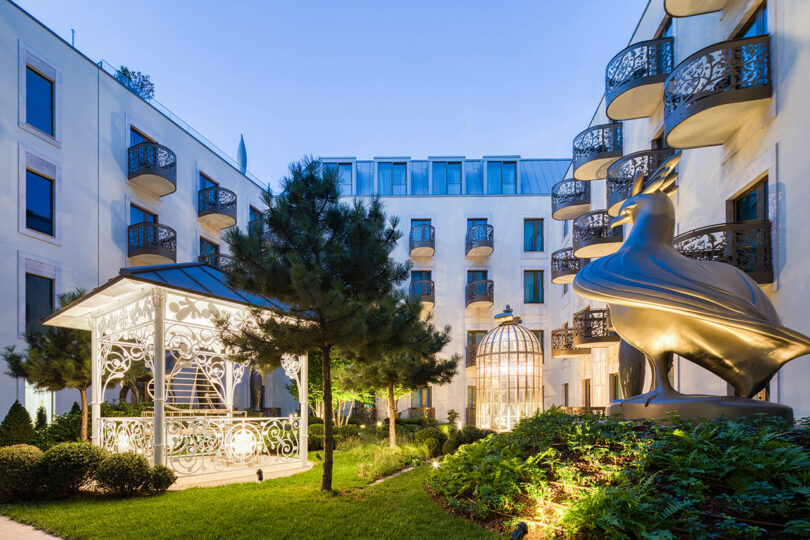
Stepping outside, the courtyard feels like a serene sanctuary away from the tourist bustle of Pest, yet it remains anchored by its heritage. The restoration preserved the grand façade, maintaining the architectural soul of the Buda side while the interior was completely hollowed out to accommodate Wanders’ "love-filled" vision. This location choice is intentional: it offers a luxury boutique experience overlooking the Danube, providing a sophisticated retreat for those who prefer the poetic whispers of Buda over the energetic roar of Pest.
"Interiors don’t have feet—if you make a hotel, you know exactly where it lands." — Marcel Wanders
The Design Concept: An Ethnographic Immersion into Magyar Legends
What is the design concept of Kimpton BEM Budapest? At its heart, the hotel is a tribute to the "Magyar" spirit—the ethnic roots and folklore of the Hungarian people. Wanders and his team moved away from the "tired white walls" of contemporary hospitality, choosing instead to dive deep into libraries, craft workshops, and local archives.
The result is a "site-responsive" aesthetic where every corner tells a story. The design philosophy hinges on the idea that a hotel should belong specifically to its location. You couldn't lift this interior and place it in London or Dubai; it is rooted in the mythological symbols of the region—the Turul bird, the Golden Stag, and the intricate patterns of Hungarian lace. It is a "fairytale-modernist" approach that balances ironic irreverence with deep cultural respect.
Mythological Symbols in Every Square Centimeter
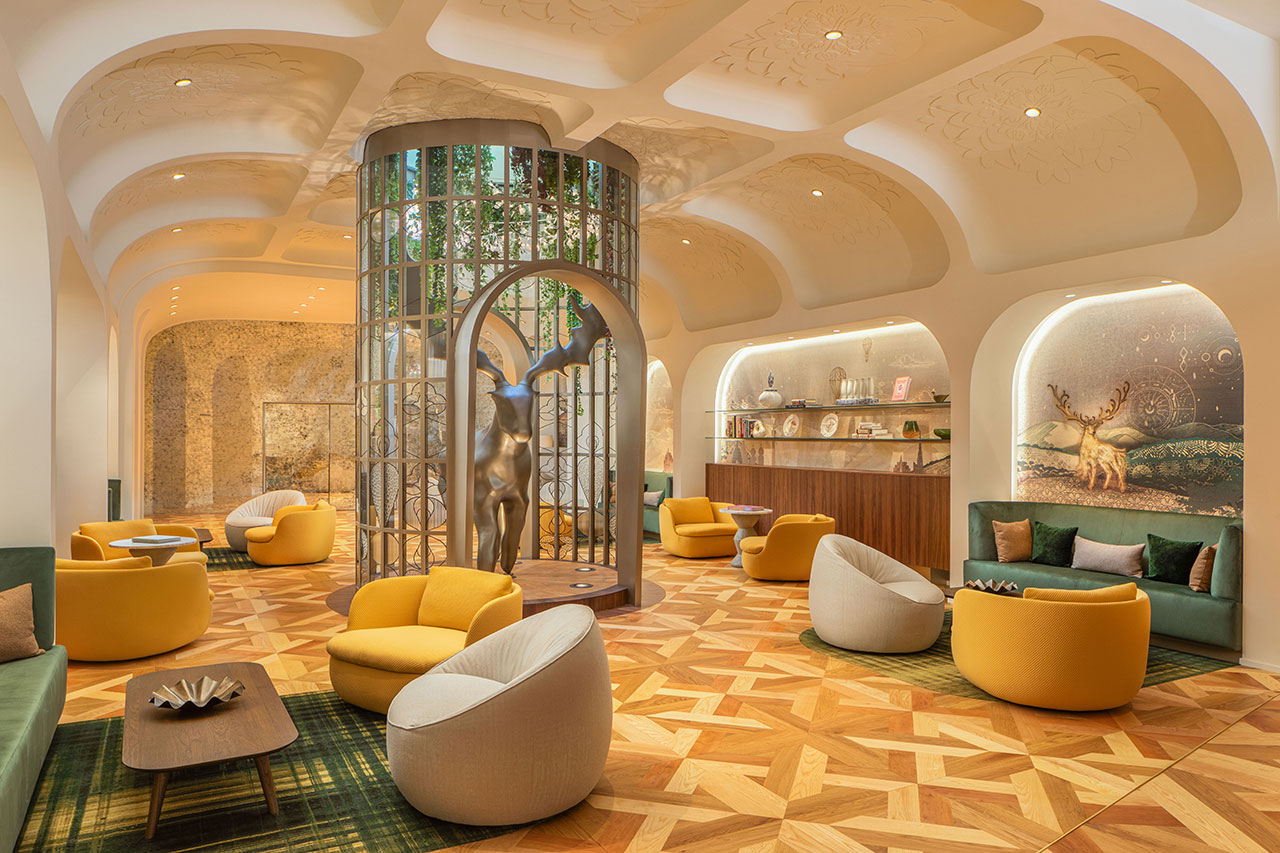
Wanders’ "Legend-to-Layout" technique is most evident in the public spaces. The atrium is a masterclass in scale and storytelling, where the central figure is the Golden Stag. In Hungarian mythology, the Golden Stag led the brothers Hunor and Magor to the land that would become Hungary. Here, the Stag serves as a literal and metaphorical guardian of the space.
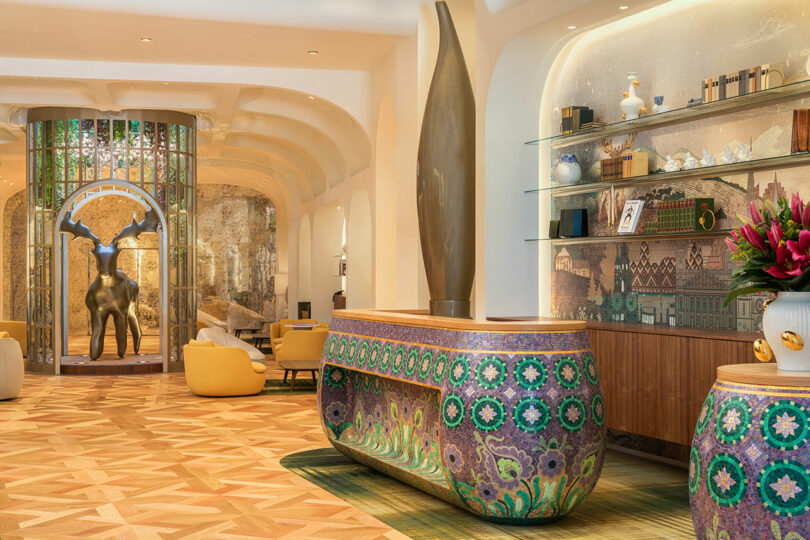
The craftsmanship throughout the lobby is astounding. The reception desk, for instance, is shaped like oversized, upside-down ceramic eggs, covered in intricate mosaic patterns that reference local pottery traditions. High-impact phrasing like "celestial ambiance" feels appropriate here, as the natural light from the glass ceiling washes over these mythological totems, creating a space that feels more like a contemporary art gallery than a check-in desk.
Sleeping in a Storybook: Guest Room Collections
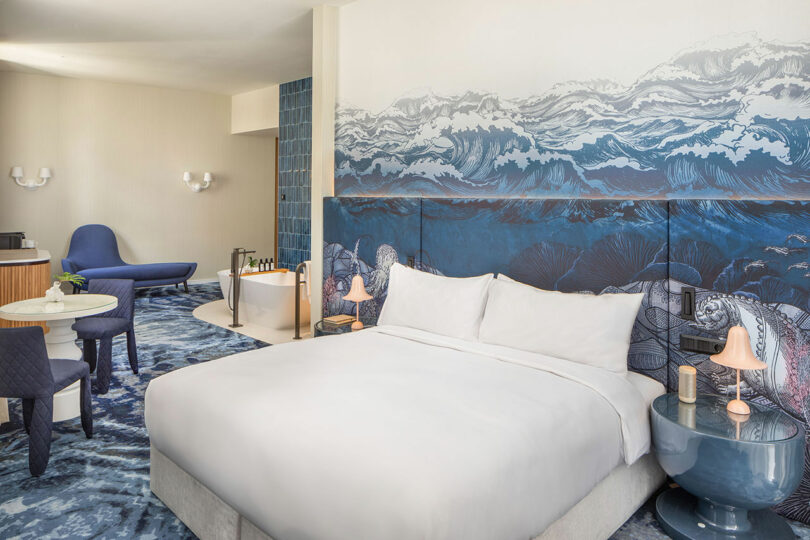
The narrative continues seamlessly into the 127 uniquely designed boutique guest rooms. Wanders has avoided the cookie-cutter luxury feel by categorizing rooms into the "Essential" collection and "Premium Danube" suites. Each room serves as a private enclave of Hungarian folklore, featuring custom-designed wallpapers and textiles.
| Feature | Details |
|---|---|
| Total Guest Rooms | 127 |
| Room Categories | Essential, Premium, and Signature Suites |
| Starting Rates | From approximately $197 per night |
| Design Themes | Poppies, Tulips, and 'Water Blue' palettes |
For the suites facing the Danube, Wanders utilized a "water blue" palette, bringing the river's calming influence indoors. These rooms often feature freestanding bathtubs positioned to offer views of the historic cityscape, blending high-end comfort with architectural drama.
Culinary Folklore: AGOS and Bar Huso
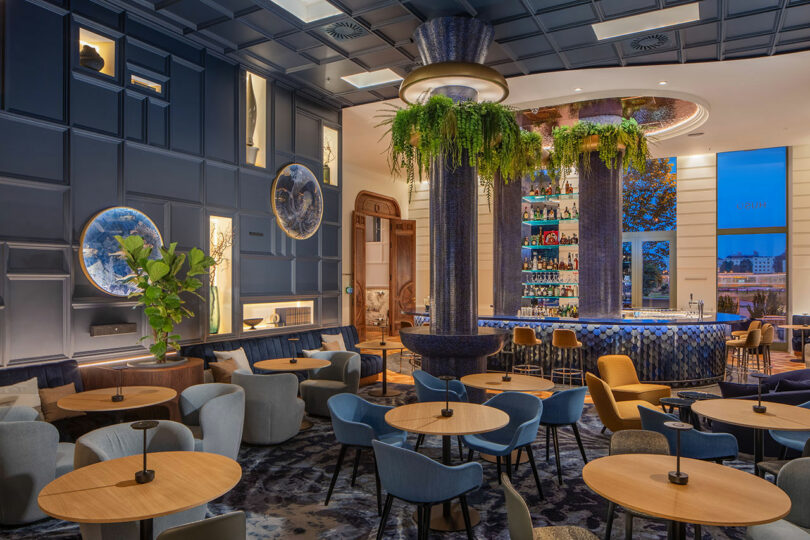
Moving from the guest rooms to the dining spaces, the design shifts into a sensory overdrive. AGOS, the hotel’s flagship restaurant, is designed like a mythological grove. The space is anchored by "totemic columns" and a mega-chandelier that mimics the organic forms of forest flora. It is a space designed for "ethnographic immersion," where the food (a blend of Mediterranean and Hungarian flavors) is mirrored by the complexity of the decor.

Then there is Bar Huso, the hotel’s subterranean-inspired cocktail lounge. Its name and aesthetic are inspired by the Huso huso (the beluga sturgeon), a legendary fish of the Danube. The bar captures an "under-the-river" aesthetic, dominated by deep blues, iridescent finishes, and aquatic textures that make guests feel as though they’ve slipped into a celestial grotto.
The Wanders Philosophy: Why "Not Everyone Should Like It"
One of the most refreshing aspects of the Kimpton BEM is its intentionality. Wanders has famously stated that if you want everyone to like your design, you end up with something mediocre. By leaning into maximalism and folklore, the hotel attracts "open-minded" travelers—those who appreciate "ironic irreverence" and artistic depth.
Sustainability at Kimpton BEM isn't just about LED bulbs; it’s about the longevity of design. By using high-quality local materials and creating a space that people feel an emotional connection to, Wanders ensures the hotel won't need a "refresh" in five years. The metallic Turul Bird sculpture in the courtyard, for example, is built to age gracefully, becoming a permanent part of Budapest's architectural landscape.
FAQ
Where exactly is the Kimpton BEM Budapest located?
The hotel is located on the Buda side of Budapest, specifically at Bem József tér. It occupies the historic Radetsky Barracks, offering a quieter, more local experience while still being within walking distance of the Danube and Margaret Bridge.
What makes the design of the Kimpton BEM unique compared to other luxury hotels?
Unlike the minimalist "safe" designs of many luxury chains, the Kimpton BEM uses a maximalist approach led by Marcel Wanders. It integrates specific Hungarian mythological symbols—like the Turul bird and the Golden Stag—into every architectural element, making it a "storytelling hotel."
Is the Kimpton BEM Budapest pet-friendly?
In keeping with the Kimpton brand's "Forgot It? We’ve Got It!" and pet-friendly philosophy, the BEM Budapest welcomes pets of all sizes at no extra charge, making it a rare luxury find for travelers with four-legged companions.
Final Thoughts: A New Standard for Boutique Luxury
The Kimpton BEM Budapest is a triumph of narrative-driven design. It proves that luxury doesn't have to be quiet, and history doesn't have to be dusty. By entrusting a 19th-century landmark to a visionary like Marcel Wanders, the IHG group has created more than just a place to sleep—they’ve created a landmark that honors Budapest’s past while hurtling toward a vibrant, artistic future.
Whether you are a design aficionado or a traveler seeking a deeper connection to the cities you visit, the BEM offers a masterclass in how to live inside a legend.